

Esoteric announced that the K-05XD player had won fairaudio’s Favourite Award for 2024. Pretty cool!
“We are proud to announce that our ESOTERIC K-05XD SACD/CD Player has been honored with the prestigious fairaudio’s favourite award for 2024!
This recognition highlights our unwavering commitment to delivering exceptional sound quality and craftsmanship. A heartfelt thank you to fairaudio for this esteemed acknowledgment and to our loyal customers for their continued support. Here’s to more extraordinary musical experiences ahead!”
I’ve reproduced the review below (translated from German):

I felt like I was back in the good old days of high-end CD players when the editors offered me the new Esoteric K-05XD to test (price: 13,500 euros; web: www.aqipa.com ). Since the end of the 80s, I have been fascinated by finely engineered CD players – like the Sony 557 (although my Sony was three sizes smaller for budget reasons) or Esoteric’s bombshell in its debut year of 1987: the combination of CD transport and DAC P-1/D-1. Even years later, this fascination has not changed much for me, and after SACD players from EMM Labs and dCS, a TAD D1000 MkII has been in my rack for a good four years and serves as my reference. I am excited to see what the new Esoteric has to offer.
Weighty entry
The Esoteric K-05 has been around since 2012. Despite the same design language, a lot has changed since then under the Esoteric’s perfectly crafted aluminum casing, and so the current K-05 with the “XD” suffix no longer has much in common with its predecessors. In what is now the third evolutionary step, the Esoteric has not only visibly increased in height, but also significantly in weight – from 14 to almost 21 kilograms – and currently marks the entry-level SACD player of the brand. In order to accommodate the additional electronics and mechanics in the new K-05XD, Esoteric has given its entry-level model the housing of its larger siblings, the K-03XD and K-01XD.

The Esoteric K-05XD marks the entry into the Japanese SACD/CD player range – with a weight of over 20 kilograms, this is admittedly a rather “massive” entry. The current third version of the player/DAC has been given a higher housing so that the electronics also have their place
Two-story
When you look under the loosely fitting aluminum top plate (more on that later), you can see that the latest incarnation of the player/DAC is no longer just a further development: While the layout in the previous versions was visually almost indistinguishable from each other, the K-05XD is now divided into two levels: The drive resides on the upper floor together with the almost mirror-symmetrical digital board – and below that, three power supplies are arranged together with the analog sections.

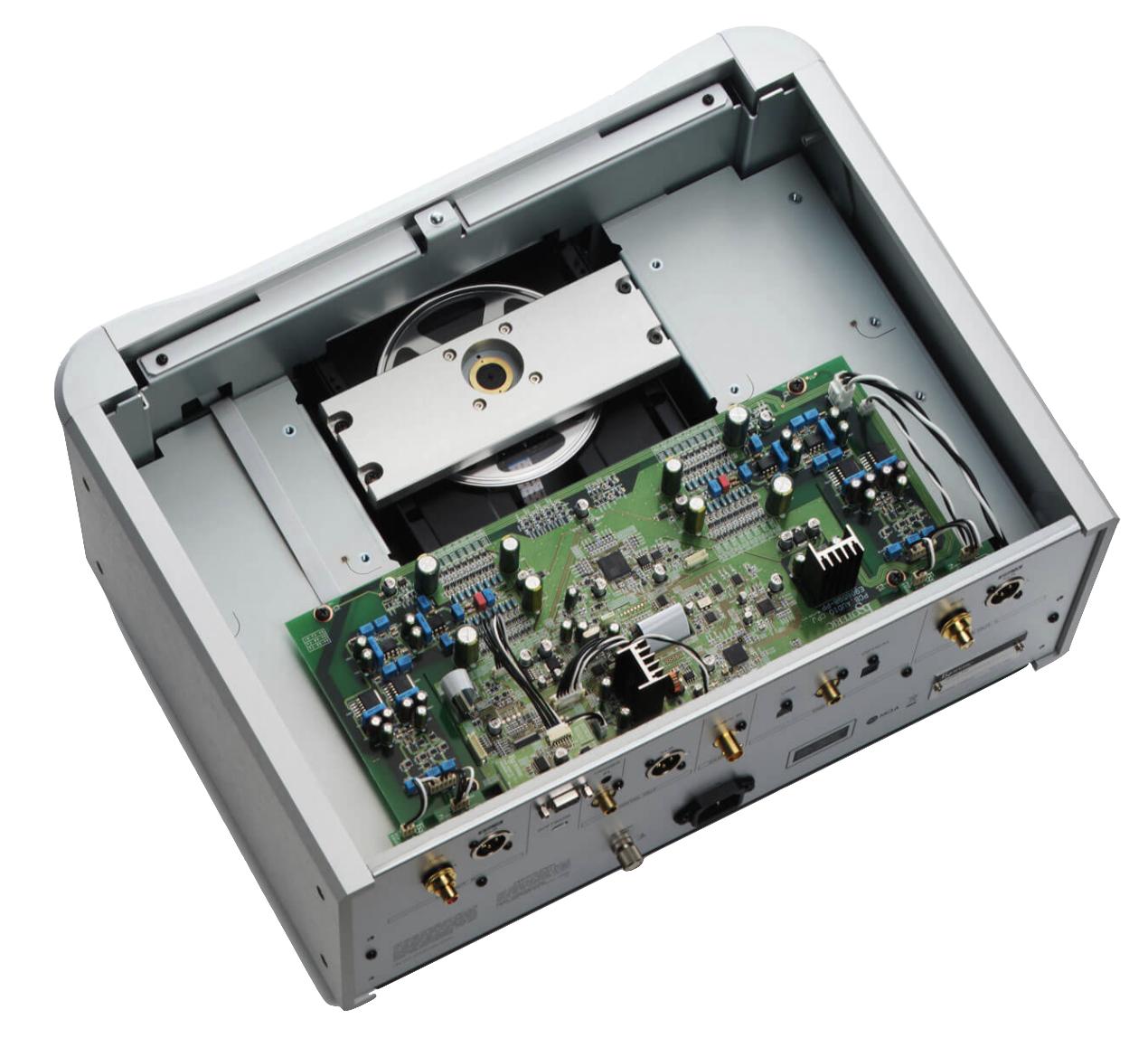
But first things first: Anyone who hears Esoteric or Teac will immediately think of the famous VRDS drives (Vibration-Free Rigid Disc-Clamping System). While the K-05Xs still used the VRDS-NEO drive introduced in 2003, the current K-05XD has the newly developed, larger VRDS-ATLAS-05 CD transport, which is based on the VRDS reference drive installed in the ultra-high- end Grandioso series. Even visually, this drive is a small mechanical marvel that, in my opinion, is hardly inferior to analogue record players.

My expectations of the new ATLAS-05 transport mechanism are high – but they are dampened a little by the slight plastic noise when the CD tray is pulled out. Well, what the heck, the tray isn’t that important for playing the CD. The more important thing is the turntable, which sits on top of the CD – and is deliberately made from a hybrid aluminum-polycarbonate mixture, according to the Japanese. This is intended to minimize rotational noise and rotational inertia.
But of course not only the turntable but also the rest of the transport unit has been fundamentally redesigned and made even stiffer and more solid than the VRDS-NEO transport, and the installation center of gravity has been lowered. The aim was to minimize sound-damaging vibrations that could be caused by the rotational movement in order to make the readout process as trouble-free as possible.

“Freedom from interference” is also the key word when it comes to the power supply. The Esoteric K-05XD uses three separate power supplies: one toroidal transformer for the digital and analog circuits, and a low-interference EI core transformer for the control functions. For comparison: the power supply in the predecessor K-05Xs was only provided by a single power supply – albeit one supported by a 330,000 μF filter capacity. According to Esoteric, the revised power supply should bring more punch and depth to the sound. I’m excited.
D/A converter
Let’s get to the heart of every digital player, the converter section. Here, the predecessor K-05Xs still used a 32-bit DAC AK4493 from Asahi Kasei Electronics (AKM). After the fire in October 2020 at the AKM factory in Nobuoka, Japan, many manufacturers were forced to switch to alternatives such as the very well-reputed ESS-SABER chips (the DACs from Lumin , CanEver and Ideon Audio that I previously tested are also equipped with them). But not esoteric. Fortunately, the AKM DACs had already been phased out with the revision of the “X” version of the Grandioso D-01 presented the year before and a 64-bit in-house development had been used. So what could be more obvious than to make a virtual out of necessity and use the new DAC in a derived form in the “small” Esoteric K-05XD?

The “64 Bit Master Sound Discrete DAC” built into the K-05XD is controlled by an FPGA (Field Programmable Gate Array) and uses a 64-bit/512Fs delta-sigma modulator, similar to that of the previously tested Esoteric N-05XD streamer preamplifier. The proprietary and discrete delta-sigma modulator, ie constructed from individual components, supports practically all formats that streaming and download portals currently offer, up to DSD512.

The concept of the delta-sigma converter actually requires oversampling and usually analogue or digital filtering of the signal. However, there is a surprise hidden in the filter settings of the K-05XD, namely the filter setting “OFF”. According to the manual, this bypasses the digital filter. Esoteric understandably does not want to reveal how exactly this has been implemented. But more on the fact that this special approach was worth it in terms of sound – more on that later.
Little things?
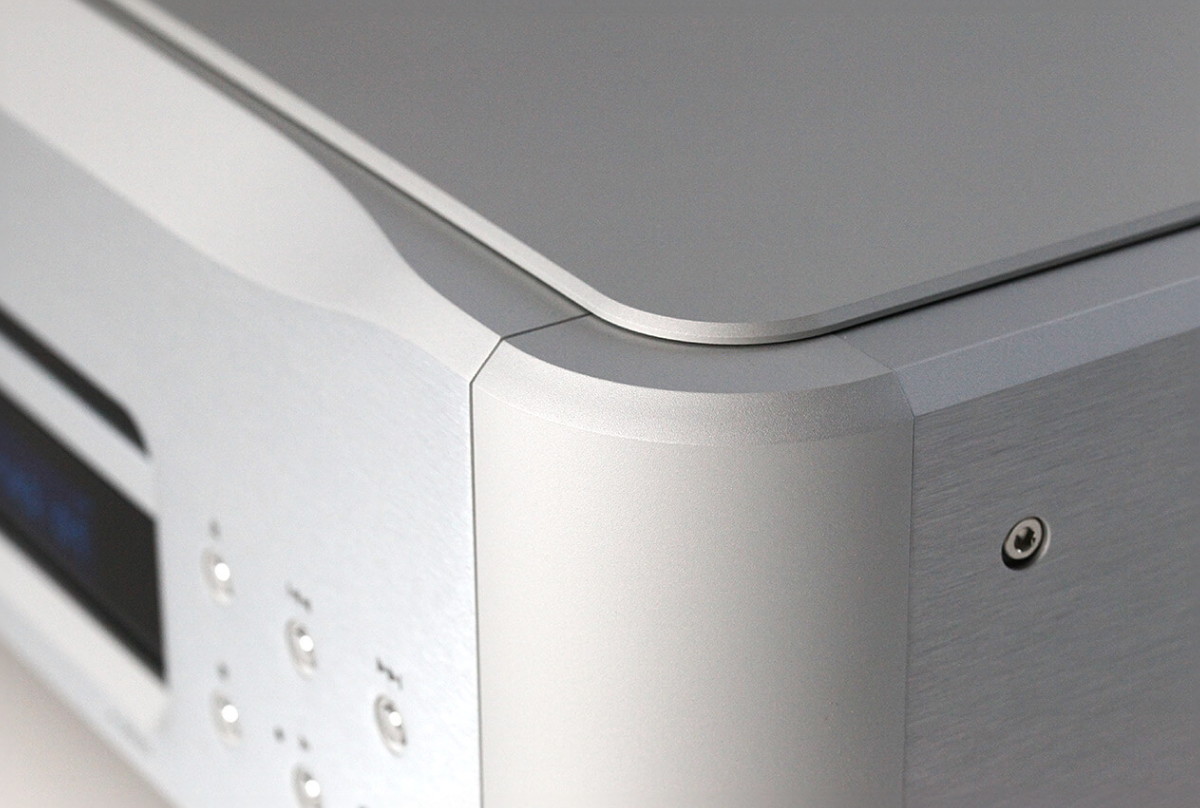
The new, height-adjustable device feet with spikes and integrated coasters show how much Esoteric has taken into account even seemingly small details in the design of the new K-05XD. These were also taken from the Grandioso series, as was the new, loosely placed device plate, which, according to the Japanese manufacturer, is supposed to support a more expansive and open sound compared to the screwed plate of the predecessor. This is also the argument of the Japanese competitor Soulnote, which follows a similarly unconventional approach, but goes even further with the new A-3 integrated amplifier .

A small criticism from me: The fact that the Esoteric K-05XD can be used as an external D/A converter is great, but I would have liked a little more choice when it comes to digital inputs: You can only connect from a streamer , for example, once via USB-B , S/PDIF coaxial and optical. That’s it. Unfortunately, you won’t find any inputs such as AES/EBU or I2S.

On the output side, the K-05XD offers the choice between the combined XLR and Esoteric’s own “ES-LINK Analog” output and unbalanced RCA outs . ES link? This is a method of transmitting analog audio signals between Esoteric components, in which around 100 times higher currents flow than conventional voltage transmission. This should make the transmission less susceptible to interference and minimize cable influences. Krell also uses a similar method of signal transmission with the CAST process. In the absence of a compatible power amplifier, however, I wired my pre-end combination for the test via XLR.
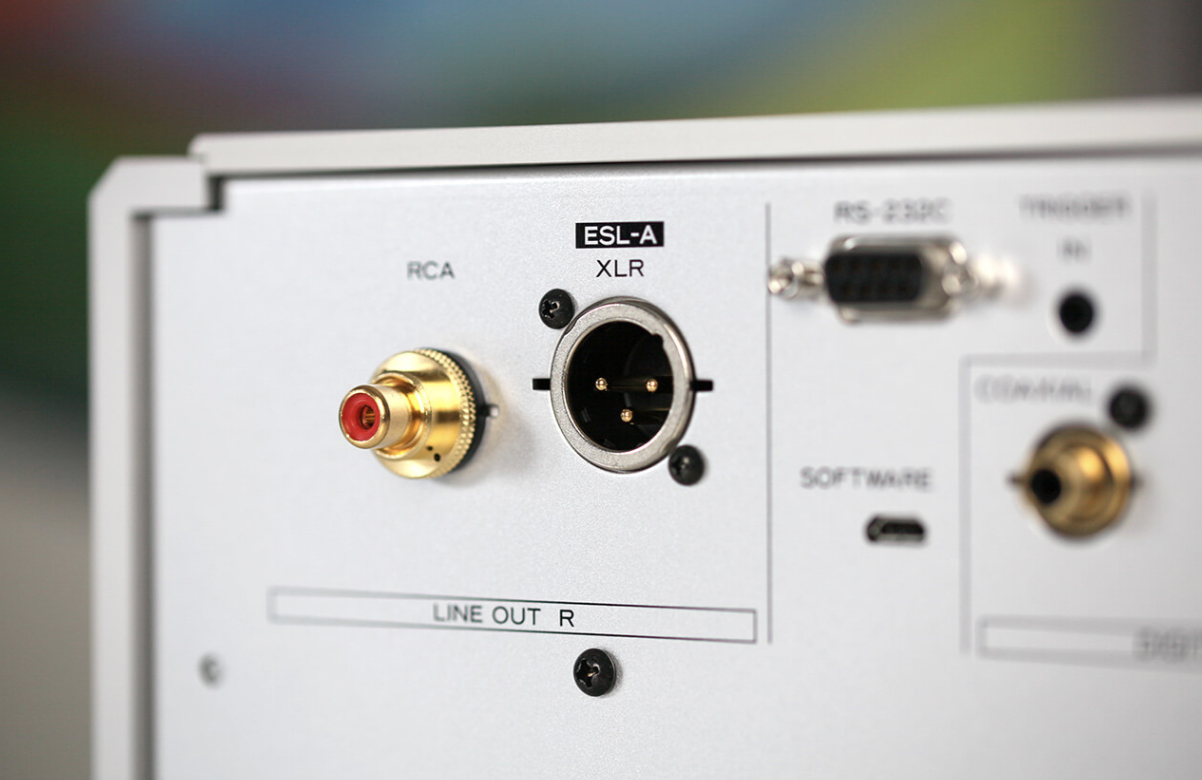
Before I forget: Of course, the K-05XD offers the Esoteric-typical option of connecting an external 10 MHz master clock (50 Ohm) via BNC cable. But now for the listening impressions!
Esoteric K-05XD: Hearing test and comparisons
Speaking of cabling: Since my Grandinote amplifiers are symmetrical, I connected the Esoteric to my Italian preamplifier accordingly. I tried both an Oyaide USB cable and a Toslink cable from Wireworld between my modded Lumin U2 Mini streamer and the test object. And without giving too much away, I can say in advance that the Esoteric K-05DX impressed me quite a bit during the break-in phase. Why am I mentioning this now? Because I can think of a whole series of digital devices off the top of my head where this was not the case. These devices had to run for much longer before their sound potential was fully developed.
The first impression: not at all esoteric
Esotericism with a “k” is often associated with occultism (from the Latin occultus: hidden, concealed). There is no trace of this in Esoteric with a “c” – quite the opposite.

I’m in my home office and the Japanese player is just playing my Qobuz playlists in the background when “Fistful of Steel” from Rage Against The Machine ‘s debut album suddenly starts blaring. I turn the volume up, after all, you have to hear a song like this loudly… and I quickly realize that I’ve probably never heard “Fistful of Steel” presented so cleanly and powerfully. Mastering engineer Bob Ludwig really did a great job back then: when the hard guitar riffs start at around 4:45 minutes, the Esoteric manages to separate them clearly from one another – nothing is smeared or annoying, despite the heavy volume.
Now that the K-05XD has warmed up to streaming in the truest sense of the word, the ATLAS-05 drive can finally show what well-made precision engineering can do against streaming technology. For this purpose, I have already prepared a stack of CDs and SACDs, some of which are also on my NAS.
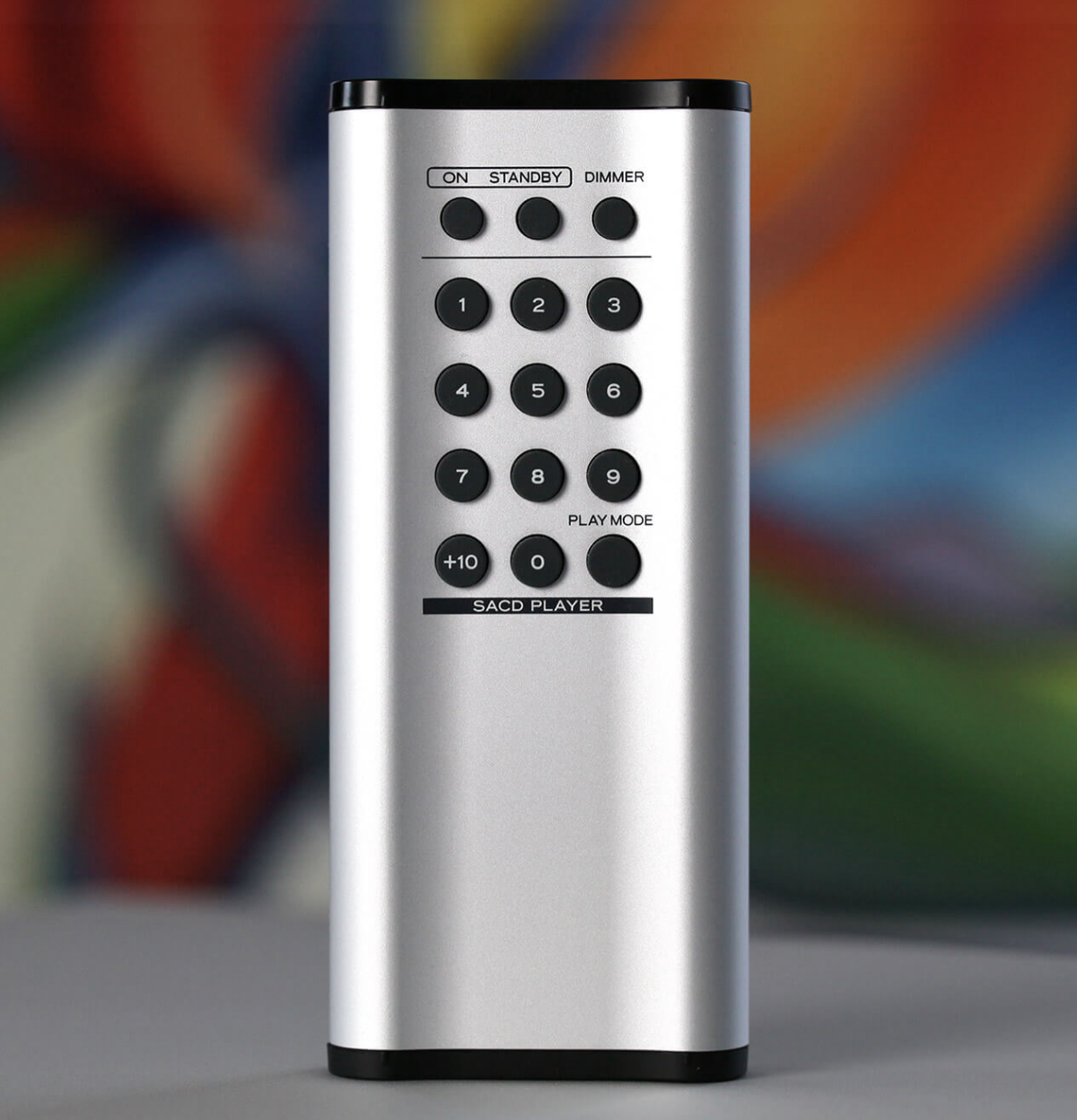
To start the listening session, one of my first SACDs, Norah Jones ‘ debut album Come Away With Me from 2002, goes into the player. Using the K-05XD’s unusual two-sided remote control, I select track number five, “Don’t Know Why,” and listen impatiently to the first notes. After just a few seconds, I get the impression that the Esoteric is at the forefront when it comes to clarity and clean reproduction. All of the instruments are reproduced with surgical precision against a deep black background: the acoustic guitar slightly at the top right, an electric guitar to the left of it and slightly lower, Norah’s piano in the center, and the bass also in the center, but discreetly in the background. It seems as if the Esoteric is cleaning and dusting off any interference from the entire sound image: every single note is sharply outlined and stands out against a completely black background.
Speaking of which: It took me years until the blackness of disc playback also appeared when streaming. Now, however, streaming, whether from the NAS or the Internet, is almost indistinguishable from CD/SACD sound. This also applies to the Esoteric. My descriptions of the sound therefore apply to the K-05XD as a player and as a standalone DAC.

Actually, there is no need for a direct comparison for this first sound classification. The difference in character to my TAD D1000 MkII is too clear: With the TAD premium player, Norah Jones’ voice sounds a little less present, even a little muffled. On the other hand, some might find the less direct response to be “more pleasant” or “atmospheric”. This is consistent with the fact that the TAD made Norah’s piano touches a little less prominent and paid more attention to the finer nuances such as the brushes on the drums that set the beat.
Dynamics and bass
The excellently recorded SACD Polarity by the Norwegian trio Hoff Ensemble is also rich in subtle nuances . The piece of the same name is essentially carried by virtuoso piano playing and drums and starts melodically and calmly. The first two minutes reveal the fine dynamic talents of the Esoteric K-05XD: the Japanese high-end player converts the gentle sweeping of the brush or the delicate piano touches into the finest volume nuances. When the ensemble then gradually increases the tempo, the player simply goes along with it and every note is passed on with firm footing and unrestrained dynamics.
The dynamics are a little more direct and powerful with the electrician Bob Moses and the song “All I Want” (from the CD “All In All”). The song begins with a pounding, dull bass, from which the theme slowly develops. The sheer force of the bass waves would be enough to musically overwhelm everything – if the K-05XD wasn’t so good at controlling the bass with a firm hand. In purely quantitative terms, it doesn’t tend to exaggerate in the lower range, although it does reach out more forcefully than timidly. An Ideon ION+ DAC or the CanEver ZeroUno SSD have more “mass” in this respect. The Ideon in particular adds a little more at the bottom and behaves like Mike Tyson in the sound competition, while the Esoteric with its fast, contoured, but still powerful bass is more reminiscent of Muhammed Ali. My TAD player is more reserved in comparison to the three and puts the vocals rather than the bass in the foreground. It is difficult to say which interpretation is “more correct”. If it is purely about the fun factor, the Esoteric is undoubtedly ahead with its minimal emphasis on the upper bass.

Speaking of which: If you want to have fun exploring the dynamic possibilities of your system, I recommend the album Paramita by He Xun-Tian from 2003, which is available in XRCD2 format. In the song “Earth Drums”, the drums seem to dance without limits across the imaginary three-dimensional stage. They use the entire width and depth of the stage. It is an impressive choreography of quick percussion and deep bass drums, down to 30 hertz at full volume. The K-05XD follows the drums with a combination of fast-paced precision and pressure, and shows what spatial illusion is possible with just two speakers.
Tonality and overall balance
Of course, as a buyer of a CD player/DAC in this price range, you can assume that it will be tonally balanced. And that is exactly what the Esoteric K-05XD does with its fairly incorruptible all-round tonality. However, compared to the TAD, I noticed that it seems to emphasize the end frequencies. But you can also see it the other way around: the TAD plays with a greater emphasis on the midrange, rounds off the highs a little at the top and is more reserved in the lower registers than the Esoteric. The latter sounds more spectacular and emotional as a result, while the TAD sounds a little more elegant and – if you can say that about an SACD player – more “analog”. For example, in Quincy Jones’ “Body Heat” (album: Body Heat), the TAD captures the mood of the classic a little more intimately and gives voices a warmer touch. Neither device is “sounded”: the TAD just seems a little more subtle at the end of the frequency range in a direct comparison, the Esoteric a little more aggressive, at least in the bass. Which “mood” appeals to one more is up to the listener.
High frequency and resolution
The Esoteric offers more in the high tones than my TAD, it resolves the fine ramifications of the cymbal in the Quincy Jones classic even better and places them more prominently in the sound. However, this “extra” high-frequency resolution does not mean that the Esoteric’s sound balance drifts towards the bright or sharp. On the contrary, it is reflected in an exemplary airiness and cleanliness. This puts the K-05XD between my “British-posh” TAD and a Lumin P1 (around 10,000 euros), which resolves high-frequency webs just as well as the test candidate, but has a slight tendency towards brightness, which the Esoteric lacks .

Another example of the quality of the Esoteric is Sting with “If You Love Someboy Set Them Free” (from the Japanese CD first edition of “The Dream Of The Blue Turtles”). Recordings from this period were often spiced up with an extra pinch of high tones, but that is not the case here. For me, the Esoteric really shows for the first time how good the mastering really is with the finely resolved jingles at the beginning of the classic. Without emphasizing the upper registers, it gives each individual jingle time to resonate and gives the metal back the shine it thought had been lost.
In my system environment, with Class A electronics that have a more “gracious” than “merciless” resolution, this signature style fits perfectly. In systems that are tuned to be a little “sharper”, the high resolution could sometimes be too much of a good thing. With The Dave Brubeck Quartet with Take Five (Japan SACD from SME Records Time Out), the K-05XD starts more dynamically and with more verve than the TAD and seems to put an acoustic magnifying glass on the saxophone. Desmond’s instrument comes across as more direct and a little sharper or less rounded than with my reference player.
Spatial representation
Telarc and Erich Kunzel: Do you remember them? Everyone who came into contact with HiFi in the 1980s knew them: the Telarc CDs with the label “DDD Pure Digital” (which was actually considered a sign of quality at the time). They had the reputation of being the ultimate in recording technology and thus became the most popular demonstration CDs of their time. I still have a few of them on my shelf, including Star Tracks II with “John Williams: Return Of The Jedi: Parade Of The Ewoks”.
This CD from the year Esoteric was founded (1987) is still up-to-date in terms of recording technology. The dynamics, resolution and spatiality are particularly impressive: I close my eyes and I am in the middle of the Star Wars film set. The realistically sized stage stretches out in its entirety between the speakers and the instruments are positioned precisely in height and depth. With the Esoteric, the orchestra is staggered a few meters into the depth, starting at the base line of the speakers, and individual instruments such as the flute are located even deeper in the room. My TAD, however, places the musicians another meter or two further back and opens up the room a little more, but remains vaguer in the depiction of the instruments and their outlines. The TAD is in good company here, because I have never experienced this exceptional image sharpness of the Esoteric K-05XD from any other DAC/player that I have had the pleasure of listening to in recent years.
The K-05XD shows the same care in the positioning of sound bodies when modeling them: whether it is the piccolo flute mentioned above, the violins or the wind instruments playing with great verve, the Japanese premium player assigns each instrument a realistic and clearly defined body in the room.
Attitude
I spent most of my time listening to the K-05XD with the default filter setting of “OFF.” Of the three filter settings, “OFF” offers the most clear and transparent sound, with sharply defined edges and slightly tighter bass.

After switching to “FIR”, the sound image becomes a little more spacious, as if with a slight Cinemascope effect, but the imaging precision loses a little and a slight (!) gray veil sets in. Nevertheless, the filter is still pleasing, for example with electronic music, because of the more impressive, exuberant spatiality. In terms of sound, the Esoteric takes a half step closer to my TAD player.
The third filter position, “RDOT”, lies in terms of spatiality roughly between the first two positions. “RDOT” plays a little more immediately and directly than “FIR”, but combines this style with a similar spatiality. However, “RDOT” does not achieve the crystal-clear transparency and calm of the “OFF” filter position.
A good 15 years ago, my colleague Ralph Werner asked:
“Is a SACD/CD player like the Esoteric X-05 actually old-fashioned these days or is it one of those devices that will be judged again in twenty years – when the big CD revival party rolls around…?”
Well, even if there is not much evidence of a CD revival yet, high-quality CD drives still fetch high prices on the used market, and there is undoubtedly demand. The new Esoteric K-05XD SACD/CD player is anything but out of date, because it contains a precision mechanical drive that is rarely found anywhere else – and it is also a D/A converter.

So if you are looking for an honest-sounding DAC with a built-in state-of-the-art SACD drive and a safe-like finish, I can only recommend the Esoteric K-05XD. Despite all the resolution, transparency and tonal honesty, listening to music is never a problem thanks to the first-class bass performance and the very good dynamic capabilities. Well – if you are primarily looking for a warm mid-range and/or a stage image that extends far forward, you will probably find more suitable representatives of the trade. But for me, the Esoteric K-05XD is a high-end device that you could only wish for: built with immense material expenditure, blessed with the best workmanship and a dreamy sound.
The Esoteric K-05XD …
- offers a balanced tonality that is at most a little more offensive in the upper bass range.
- Its fine dynamics are impressive and its gross dynamics seem to have almost no limits. Fast impulses are beamed into the listening room as if from nowhere and, if necessary, with the appropriate pressure.
- has a powerful, minimally accentuated and always controlled bass with good structure across the entire range, right down to the very lowest registers. This tuning contributes to the great musical fun factor.
- impresses with crystal-clear transparency and calmness of the sound image – the famous background blackness – especially in the filter position “OFF”.
- pleases with its fine resolution and airiness in the high frequency range. It always remains neutral and masters the entire spectrum from silky to metallic-hard.
- With its neutral and transparent mids, it is neither glossed over nor bloodless. Voices are reproduced in a vivid and catchy manner. There is, of course, no “pleasant fundamental tone increase” here.
- projects a stage that is believably large in all three dimensions on and behind the stereo base and position instruments in it with centimeter precision. He avoids exaggerations regarding the size of the room or the image in favor of precise localization and a very believable and tangible image of sound bodies that lacks any kind of sensationalism. However, if you are looking for forward-facing, immersive “sound baths”, you are in the wrong place here.
- retains its sonic character both as a SACD/CD player and as a DAC.
- weighs almost as much as a safe and has high-end workmanship inside and out. The CD drawer is not quite up to standard, but the equipment is practical – although a wider selection of digital interfaces would have been the icing on the cake.
Facts:
- Model: Esoteric K-05XD
- Concept: SACD/CD player and DAC
- Price: 13,500 euros
- Colors: Silver, Black
- Inputs (digital): 1 x USB-B, 1 x S/PDIF optical and coaxial, clock input 10 MHz (BNC)
- Outputs: analogue: 1 x XLR/ES link; 1xRCA; digital: S/PDIF coaxial and AES/EBU
- Other connections: 1 x control (RS-232), 1 x trigger 3.5 mm jack
- Dimensions & Weight: 445 × 161 × 357 mm (WxHxD), 20.7 kilograms
- Power consumption: 25 watts in idle, 0.3 watts in standby
- Warranty: 2 years
- Further information on the sales website


 Audio Satori


You must be logged in to post a comment.