
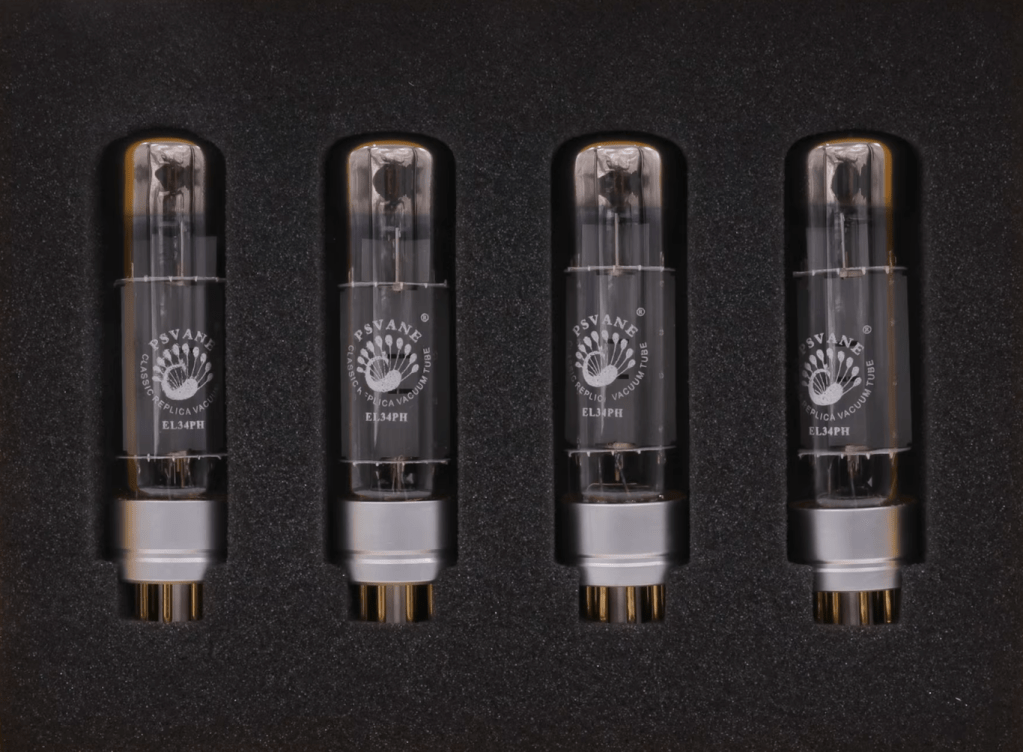
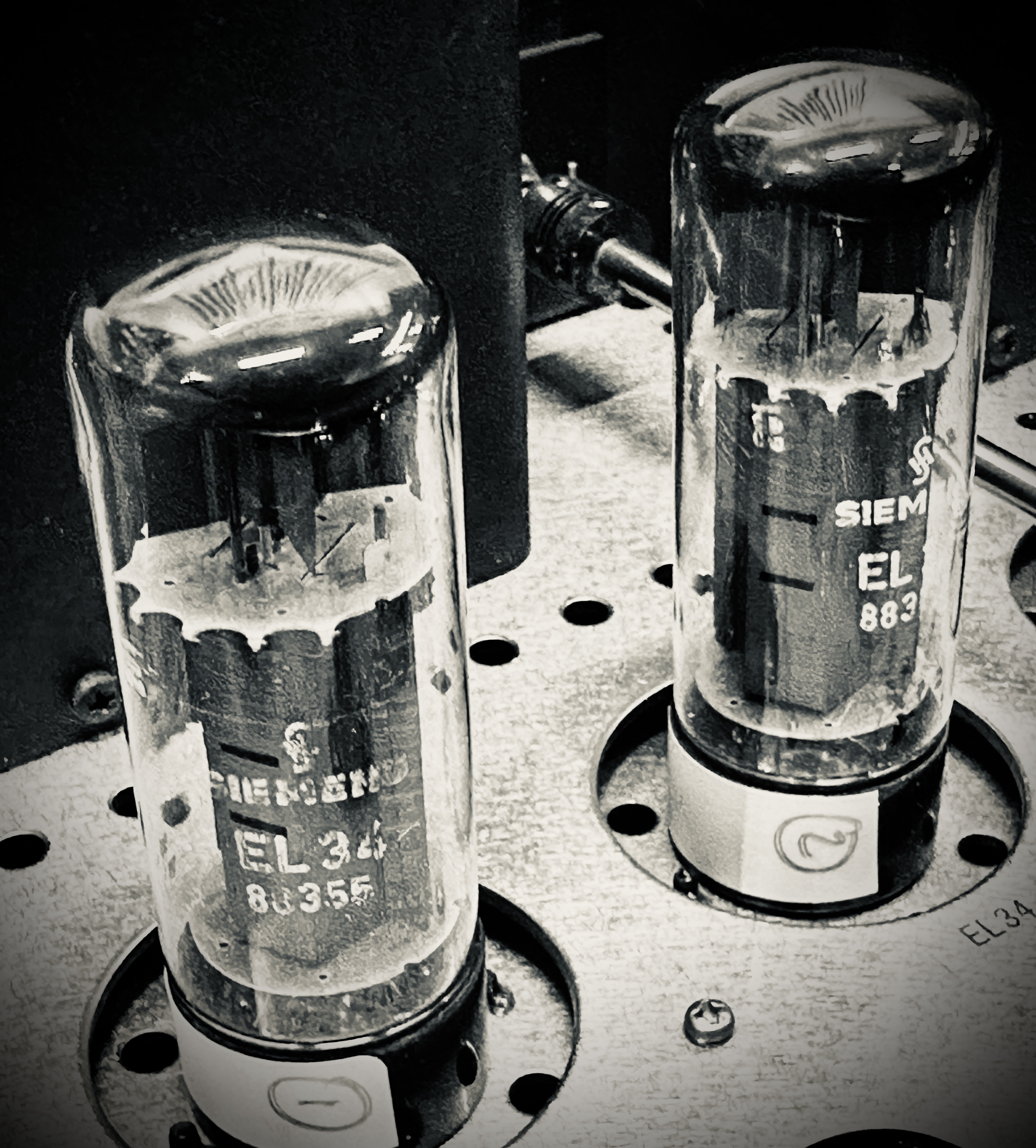
Tube rolling in a Kondo Overture isn’t just tweaking, it’s voicing. Every change makes itself known. The amp is so transparent and delicately balanced that even small differences in tubes push the sound one way or another. I have had some time recently to be able to indulge and play around with some different tubes. I have some nice tubes in the amp already in the form of some NOS Siemens/RFT EL34s, which are actually Mullard welded plate, double-O getter XF2s from July 1967, so when I decided to try the Psvane EL34PH, I approached with some hesitation. I’d been warned they could sound bright, maybe even a bit clinical. Not exactly what you’d instinctively pair with the Overture, which lives and dies by tone and nuance. Please remember, I am no reviewer, these are just my thoughts, not gospel.

Curiosity got the better of me. The Psvane EL34PH exists as an homage, an attempt to channel the soul of a legend. Specifically, it seeks to evoke the magic of the original Philips metal base EL34, crafted in Holland during what many consider the golden era of tube design. But why chase this ghost?
Because for many seasoned listeners, the Philips metal base isn’t just another EL34, it’s the EL34. The one that sings with unmatched musicality, grace, and tonal richness. The EL34 is already revered as one of the most expressive and emotionally engaging output tubes, the Philips stands apart as the pinnacle, sonically exalted, almost mythical for some.
Yet that exaltation comes with a cost. These tubes were only produced from roughly 1955 to 1958, a blink in the lifespan of high-fidelity. And so today, genuine survivors are vanishingly rare, jealously hoarded, and priced accordingly, often into the stratosphere. I have no desire to spend moonbeams of cash on a consumable item. For many, they’ve become less of a tube and more of a talisman. Psvane’s version arrives dressed for the part: clear glass, gold pins, and a surprisingly faithful internal structure. Packaged in a nice box with a test report for each serialised tube. They look like they mean business. And as it turns out, in the right context, they sound like it too.
A Short History of the EL34
The EL34 vacuum tube is one of the most iconic and enduring components in high-fidelity audio history. Developed in the late 1940s by Mullard, a British arm of Philips, the EL34 was intended as a high-power output pentode and quickly found its way into high-end British and European audio gear, where musical accuracy and tonal character were paramount.
From a hi-fi perspective, what made the EL34 special was its rich harmonic structure, open midrange, and slightly romantic warmth, qualities that set it apart from the more clinical or bass-heavy American equivalents like the 6L6 or 6550. I did love the 6L6 in my Shindo Haut Brion, and in my Leben CS-600 as well though. The EL34 became the tube of choice for many classic amplifier designs in the 1950s and ’60s.
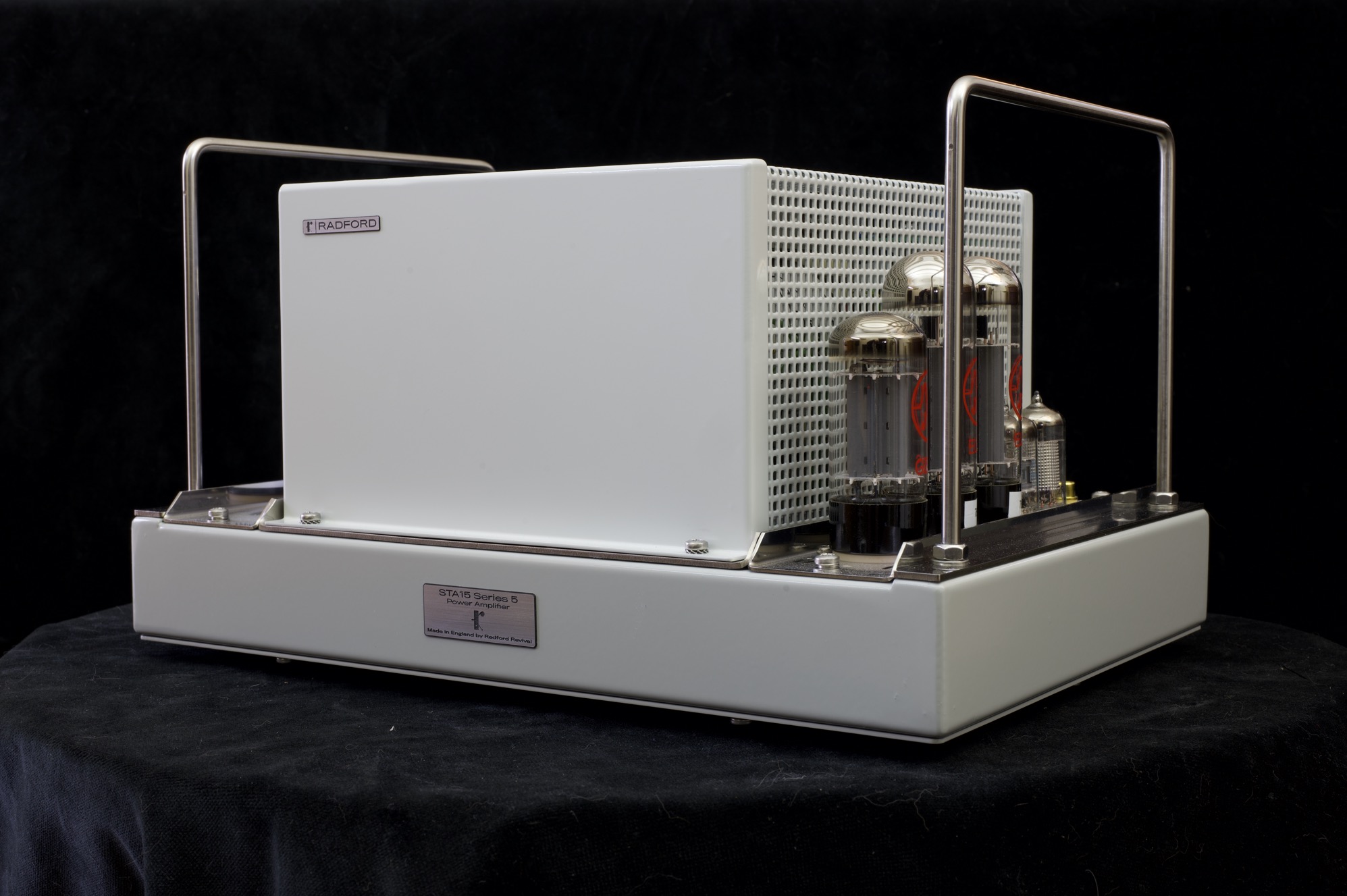
Amps from Leak, Dynaco, Radford (I still miss my STA-15), and Rogers all leaned into the strengths of the EL34. Whether in ultralinear or push-pull configurations, these amps extracted extended treble, well-controlled bass, and fast, articulate midrange from the tube. With high-quality output transformers and well-matched components, EL34 amps often delivered a sound that holds up today; musically engaging, detailed, and tonally balanced.
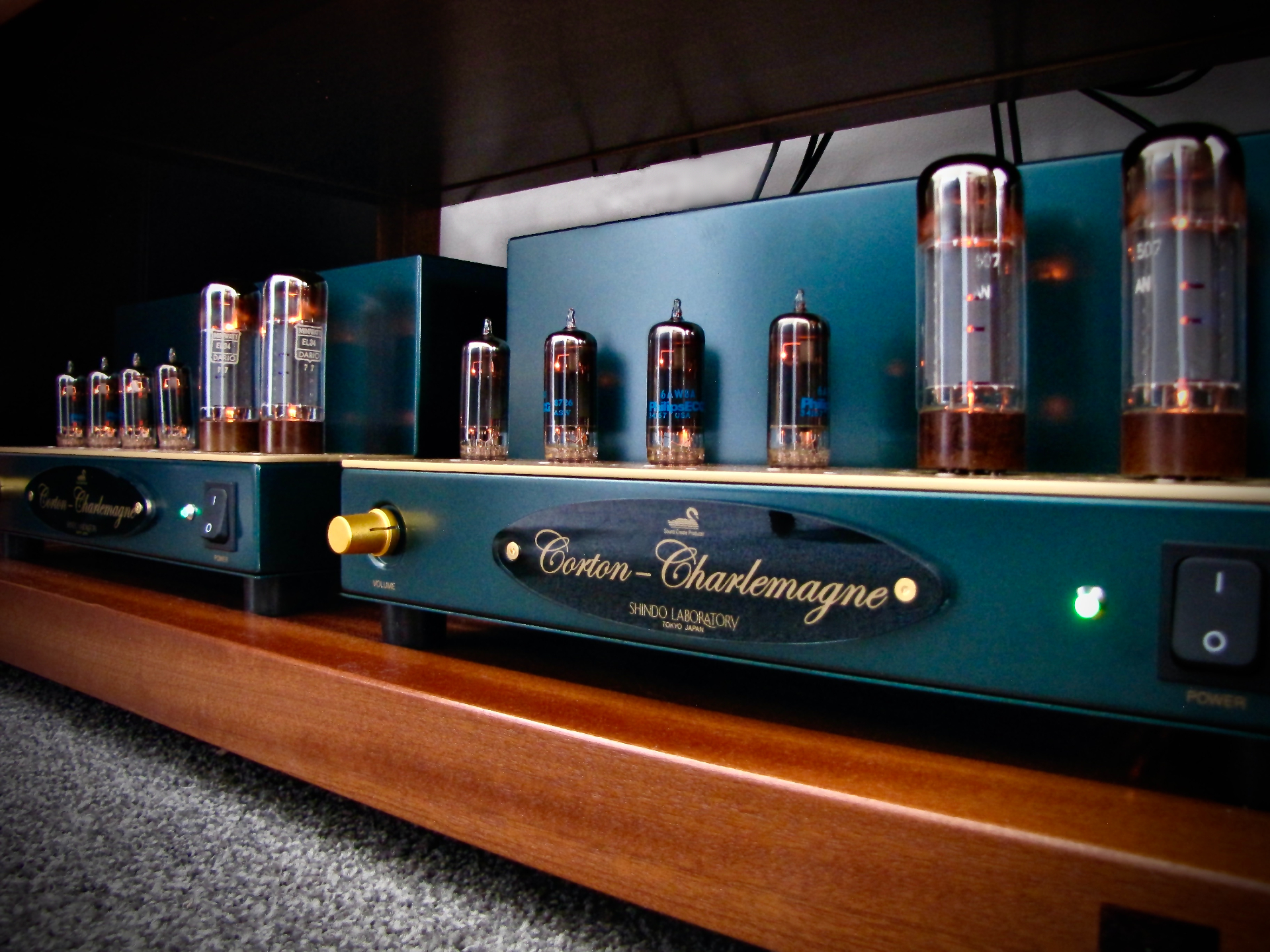
My old Shindo Corton Charlemagne’s used a push-pull pair of Dario (Philips) Miniwatt EL34s, and they were magical amps.
Technical Overview of the EL34
The EL34 is a 5-pin octal-base pentode, compact and powerful. Key specs include:
- Heater voltage: 6.3V
- Heater current: 1.5A
- Max plate voltage: 800V
- Max plate dissipation: 25W
- Typical push-pull output (pair): 35–50W
- Transconductance: ~11 mA/V
- Typical load impedance: ~3.4kΩ plate-to-plate (push-pull pair)

Its high transconductance and relatively low internal resistance give it a dynamic, responsive character, while its tolerance for high voltages supports robust circuit design. In ultralinear mode, it blends the power of pentode operation with the smoothness of triode-like linearity, presumably one reason it remains popular in both vintage and boutique tube amps.
Plugged into the Overture, the Psvanes initially came across leaner than expected. Not harsh per se, but there was a certain ‘politeness’ in the upper mids that echoed the early warnings. I held off on any verdict. After about 25 or so hours of playing time, the character changed: the midrange filled in, the treble smoothed out, and what emerged was a balanced, tonally rich sound. That early brightness mellowed into something far more natural, although probably on the leaner side of neutral. Maybe they’ll continue to change.
Comparing to Mullards
They don’t offer that fat, chewy warmth you get from some of the Russian reissues. Instead, the Psvanes lean toward texture and resolution. Strings have bite, vocals have breath, and the soundstage feels expansive without becoming airy or washed out. They walk a fine line between detail and musicality, and in the Overture, that’s exactly the balance you want.
I’ve also used modern Mullard EL34 reissues in the Overture, which are still one of the best value-for-money options out there. They’re immediately likable: bold mids, punchy bass, and a bit of that vintage colour. On the right music, especially male vocals like Einar Selvik of Wardruna, they can sound more dynamic than the Psvanes.

But next to the EL34PH, the Mullards start to feel a bit voiced, like they’re trying too hard to impress. They bring more drive and push, but at the cost of air and finesse, although still better than some. The Psvanes aren’t as bold, but they’re perhaps more honest. There’s better layering, more natural harmonic decay, and a more subtle, graceful presentation. Maybe the kind of tube that doesn’t demand attention, but keeps pulling you in anyway.
How Do They Stack Up Against NOS?
They’re not in the same league as my NOS Siemens/Mullard XF2 EL34s. The Siemens have that effortless balance no modern tube quite manages (yet), more air, tighter bass, and a harmonic density that makes everything feel real and alive. The Psvanes get you maybe 80–85% of the way there, which is impressive considering price and availability. But once I put the Siemens back in, the step up in immediacy and tonal richness was obvious.
After mentioning this to a few valve obsessives, I was pointed toward the TAD Redbase EL34-STR as another solid option, supposedly offering more body than the Psvanes, tighter control than the Mullards, and better build consistency than most reissues. I haven’t tried them yet, but they’re on the list. If they can approach the Siemens feel without tipping into sterile modernity, they might be the next ones I roll through the Overture. One friend thought they were in fact better than the Siemens.
Musical impressions:
I listened to a few different albums during this audition, on vinyl and CD:

Heilung
The Psvane EL34PH captures the ritualistic intensity and spatial depth of Heilung’s live performance beautifully. Percussive elements snap with clarity, and the midrange lifts the vocals and chants into sharp relief. There’s a sense of openness and eerie presence that fits the atmosphere well.

Wardruna
A strong match for Wardruna’s organic instrumentation. The tube handles subtle textures like breath, wood, and skin with finesse. Vocals have a natural, almost intimate immediacy, and the staging feels expansive without blurring the edges.

Om
The EL34PH brings out the meditative clarity in Om’s sound. Vocals are airy, and layered guitars unfold smoothly. It preserves the drone’s hypnotic nature, with a touch more light and definition than pure weight, ideal if you like nuance over thump.

Iron Maiden
Articulate and fast, this tube keeps up with Maiden’s twin-guitar fury. Solos cut cleanly, and drums are snappy and alive. Vocals stay centered and forward. Some listeners may find the sound a bit clean for classic metal, but it’s exciting and detailed.


Ulver (early and later)
For early Ulver, it handles the rawness and acoustic layering with grace. There’s bite when needed and softness where it counts. In the later, electronic era, the EL34PH reveals shimmer and texture with precision; clean, resolved, and slightly cool, which suits the cinematic mood.

Tenhi
A lovely pairing. The Psvane EL34PH brings out Tenhi’s melancholic subtlety, pianos, strings, and whispered vocals come across with emotional clarity and space. There’s an elegant restraint that aligns well with the band’s understated intensity.

The Bad Plus
The EL34PH highlights the trio’s sharp interplay with good speed and articulation. Piano strikes land with clarity, and the drums are crisp and dynamic. The tone leans modern and open, emphasizing detail and forward motion without getting harsh.
The Problem with NOS: Chasing Ghosts or Listening to Music?
As much as I admire what a truly great vintage tube can bring to a system, the body, the bloom, the almost alchemical musicality, I’ve grown wary of the NOS rabbit hole. My Siemens valves are exceptional, no doubt. But chasing rare glass feels more and more like a fool’s errand. The prices are insane, the supply chain murky, and the risks, well, they’re baked in. Especially when it comes to output tubes.
I’ve been offered some iconic pieces over the years. Metal base Philips EL34s? Yes. Telefunken quads? Also yes. One set came with a laughable asking price and no real proof of provenance; the others, I passed on at the time because I didn’t need EL34s, something that still lingers in the “should’ve” corner of my brain. But hindsight aside, I’ve come to believe there’s a manufactured scarcity surrounding many of these tubes. A mythology. And while some of that legend is grounded in truth, a lot feels like audiophile alchemy, just a step removed from the aftermarket fuse crowd promising jaw-dropping, night-and-day transformations.
NOS…“new old stock”, sounds reassuring, but the reality is anything but. How old is it, really? How “new” is it, if it’s been sitting unloved in a drawer since the Cold War? “Tests as new” means very little when the getter flash is pale and the glass is fatigued, and its been “tested” on an ancient uncalibrated piece of shit tester by someone who doesn’t really know what they’re doing. Worse still, there are far too many dealers out there repackaging used pulls as pristine treasures. And let’s be honest: tubes are consumables. Perishable by nature. No matter how sublime they might sound, their days are numbered from the moment they’re lit up.
Now, I know there are honest tube hunters doing noble work, scouring old factories, old stockrooms, crusty op-shops. I respect that. I respect the passion and the persistence. But for me, the equation just doesn’t add up. Too much risk, too little return. And frankly, I’d rather not gamble my real money on a ticking time bomb, no matter how sweetly it might sing.

That’s why tubes like the Psvane EL34PH matter. No, they’re not “just like” the Philips or the Telefunkens. They don’t need to be. What they are is consistent. Available. Honest. And good. Not magical, but good enough to reveal 90% of what makes an amp like the Kondo Overture special. Good enough to keep me listening, not obsessing. I’ll take a reliable tube I can replace tomorrow over a mythical one that may, or may not, survive the post.
Which brings me to the real elephant in the listening room: the ritual (or obsession) of tube rolling.
You know the type. Maybe you are the type. Changing out tubes like a sommelier pairing glass with music, chasing that perfect synergy. I get it. I know people who adjust VTA for every LP side. I even know a guy who has multiple cable looms for different musical styles! There’s something beautiful about that level of attention. Something deeply personal. If it brings you joy, carry on as you were, truly. I’m not here to tell you how to enjoy your hobby.
But for me, that path leads away from the music. Every swap breaks the spell. The amp goes cold, the tubes warm up, get re-biased, the ears recalibrate. It becomes about gear, not listening. And that’s not why I got into this. I didn’t put years of effort, and a hefty sum of cash, into a system just to audition tubes like auditioning actors. I did it so I could close my eyes and vanish into the music. That’s the magic I’m after. My spare time is valuable and limited. I don’t have the luxury to be fiddling with gear all the time, I want to be enjoying my music collection!
Imagine finding a NOS Holy Grail mo-fo set of tubes only to have one die, and never being able to find another one. It borders on tragic actually. The idea of a set of three expensive tubes languishing in a drawer unused, mourning the death of a brother is anathema to me.

I’m not tube rolling for the sake of it, I’m trying to zero in on a type I can live with long-term. Something reliable, musical, and repeatable. It’s not about chasing unicorns; rather finding a modern production tube that can deliver consistently without the baggage of NOS. Next up on the bench is the Ray Tubes range, which by all accounts are serious contenders, and seem to be gaining a quiet following. They offer two versions, the Select and the Reserve. The Select versions looks more like a conventional EL34 that we are used to, whilst the Reserve looks a bit like a KT88 and is also coated with a layer of monocrystalline carbon for improved electron flow, increased heat dissipation, and reduced noise. I’m keen to try something a little more off the radar than the usual reissue suspects. If either version can offer some of that NOS richness without the baggage, it could be a welcome alternative in the Overture. At the very least, it’s encouraging to see smaller makers experimenting and giving serious listeners more real options.
Final Thoughts
So, were the warnings about brightness justified? Not really. Not in the Overture, and not after a proper run-in. What might sound analytical or lean in a different amp comes across as clarity and tonal integrity here. I would say overall they are quite a dry sounding tube though. Having said that, I always say everything is good if used in the right context.
The Psvane EL34PH might not be the last word in slam or warmth, and they’re not a NOS killer, but they bring something else to the table: refinement, detail, and tonal truth, and availability without having to mortgage your house.
Time will tell if I have chosen poorly, or wisely.

I’ve said for years that the primary contributors to an amplifier’s sonic fingerprint are its circuit topology and output transformers. These are the structural pillars, the blueprint and the iron, that define the amplifier’s voice. Tubes, while important, operate within that framework. They don’t redefine the architecture; they shade it.
That said, tube variation is real. Different internal geometries, materials, and manufacturing tolerances introduce distinct harmonic profiles, transient behaviors, and levels of microphonic susceptibility. One tube might offer a slightly more extended top end, another a denser midrange, or a tighter low-frequency response. These aren’t transformations, they’re tonal inflections.
I suspect the engineers of the tube era, the original tube illuminati, would be bemused by the modern obsession with tube-rolling. In their view, a good tube was defined by reliability, low noise, and consistency over time. Sound was secondary to stability. But for us today, especially in high-resolution, minimalist signal chains, these small tonal shifts have become part of the art. And perhaps that’s valid too.
Of course, I haven’t even thought about playing around with the preamp side of things, but I have some ideas for trying out some other 12BH7s, namely the TAD Redbases. I’ll get to it, eventually.



 Audio Satori
You must be logged in to post a comment.