

Another new box from Fonolab, this time, the Veliferi. I’m not here to dissect or sell, just to share a few thoughts after spending real time with it.
My entry point into Fonolab was the Eqves, which was simple, quiet, and effective. It let the system breathe, without adding weight or colour. I liked that about it, it didn’t draw attention to itself too much. It made the music feel grounded.

But as I run multiple arms and cartridges, I wanted more flexibility. Not different sound, but better access: easier switching between MC and MM, loading options, the ability to bypass the transformer entirely. Basically, I wanted the Eqves, but more functional.
That’s exactly what the Veliferi is. Same core sound, same Tamura transformer (although I could have chosen a Lundahl), same minimalist approach. But it adds features that make day-to-day use much easier if you’re serious about analog. Front-panel loading, input switching, MM bypass, mono summing, it’s all there and done cleanly.
It comes in a nice clean white recycled box, and includes a ground wire as well, although I found I didn’t need it. The instruction leaflet is printed on a nice washi type paper.

Tamura
Tamura Corporation has a long and storied history, dating back to its founding in 1924 in Japan. Originally established as Tamura Radio Store by Hajime Tamura, the company started by manufacturing components for radios during the early days of Japanese broadcast technology. Over the decades, Tamura expanded its expertise into magnetic components, audio transformers, and power electronics. By the mid-20th century, they had earned a reputation for producing high-quality transformers, particularly prized in the audiophile and broadcast industries for their precision and sonic clarity.In the tube-era hi-fi golden age, Tamura became a go-to brand for output transformers, power transformers, and chokes in high-end Japanese and global audio gear. Many of their transformer models remain legendary among tube amplifier builders and restorers.
Today, Tamura Corporation is a global company with divisions in electronics, power supplies, and industrial automation, but in audiophile and DIY communities, the Tamura name still evokes the craftsmanship and tonal excellence of their vintage and modern audio transformers, especially their step-up transformers for MC cartridges, prized for neutrality, dynamics, and build quality.
In the System
The sut feeds into my Kondo GE-1, which is a revealing phono stage and doesn’t hide upstream issues. The Veliferi just works. It doesn’t try to make its presence known, it lets the rest of the system do its thing. Tone is full, detail is intact, and dynamics feel alive. There’s no sense of constraint or gloss.
With a Denon DL-103, it’s punchy and grounded. With an SPU #1S, it gets richer and denser, but keeps the focus. Switching to MM with my favourite Grace F9e and using the bypass, it’s fast and clean. There’s no obvious change in character, it just gets out of the way.

Extras
The phase equaliser was unexpected. I assumed it was a technical curiosity, but I ended up leaving it on. It tightens things slightly, improves image focus, especially with older or spatially complex recordings. Doesn’t change the tone, just reduces a kind of low-level blur you don’t notice until it’s gone.
This is what the fonolab site says about the Phase Equaliser:
‘Phono cartridge equaliser that compensates distortion added by the moving parts of the cartridge generator into the useful signal.
Mechanical resonances in the design of the cartridge body, cantilever and its suspension affect the value of parasitic magnetic resistance, which negatively affects the magnetic field that occurs during the operation of the cartridge.
The total magnetic resistance is frequency dependent and has a direct effect on the output signal, the equaliser allows you to minimise the parasitic magnetic resistance.
As a result, the overall magnetic resistance inside the cartridge is cleared of the resonant part and allows the cartridge to more accurately reproduce the signal recorded on the record track.
Musical images become more expressive and brighter, the sound field is cleared, revealing the finest nuances previously hidden by a misty veil.’
The mono/stereo switch might seem minor, but it’s not. Summed mono sounds more locked-in, quieter, and more centred, especially on well-pressed older records. A small feature, but one I missed until I had it again.

Conclusion
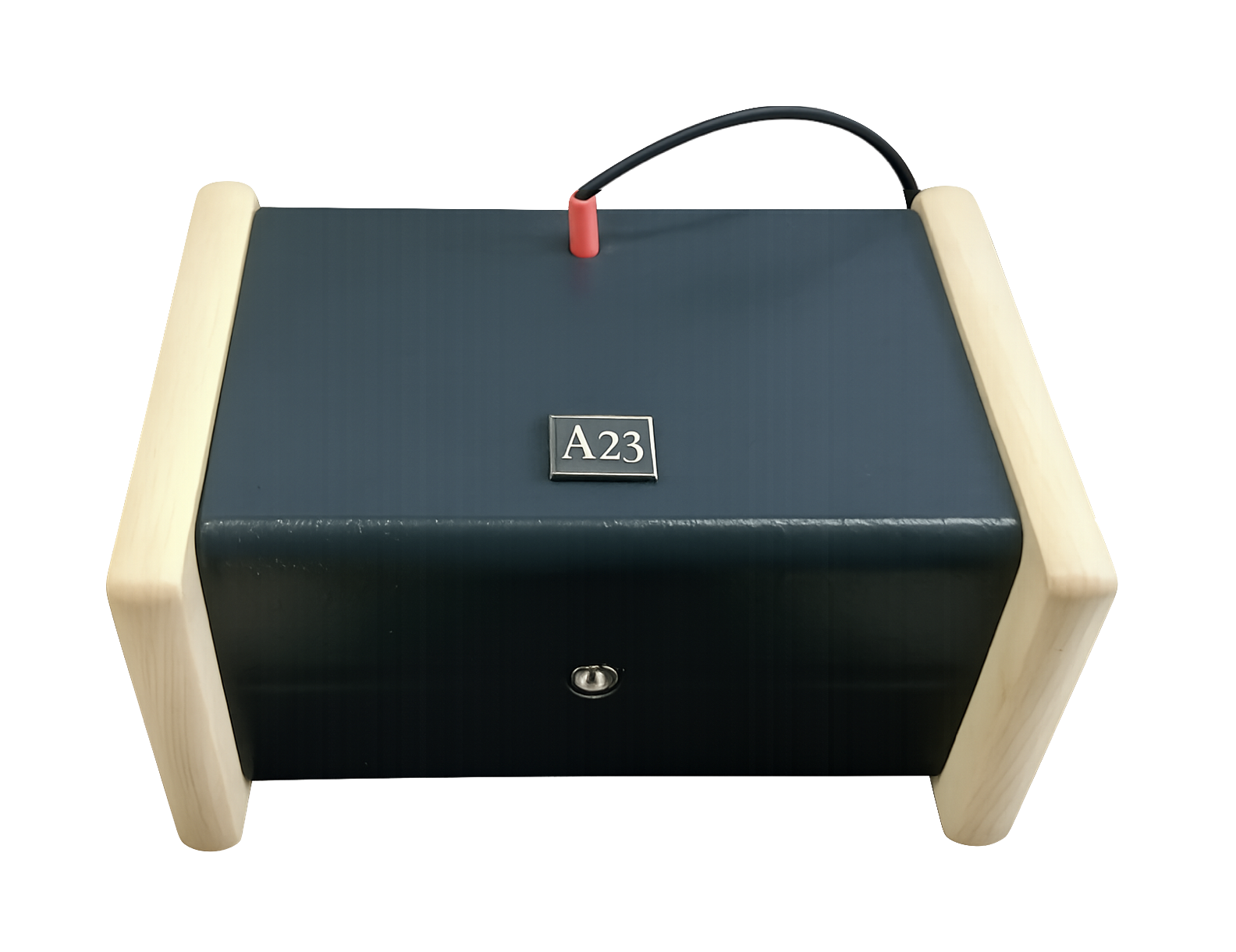
Compared to something like my legendary (and sadly discontinued) Auditorium 23 Hommage T1 and T2, the Veliferi takes a different path. The A23 units are still my benchmark for fixed-ratio SUT transparency, there’s an elegance and ease to them that’s hard to fault. But they’re locked in: one cartridge, one setting, and that’s it. You’re not trading sound for function here. You’re sort of getting both. It’s not trying to beat the T1 or T2 at their game, which I think is an unrealistic idea, it’s playing a broader one. The A23 units are still a step above in terms of pure sonic grace, there’s a kind of flow and presence and spectral coherence to them that’s hard to match, especially if your system leans toward high-efficiency speakers or SET amplification. They trace their lineage back to the Western Electric 618, and you can hear that heritage: saturated tone, beautiful spatial layering, and the kind of unforced presentation that’s rare. But they’re also fixed, you get one ratio, one loading, and no flexibility. The Veliferi doesn’t try to outdo the A23 in absolute refinement, but brings with it a level of adaptability and ease that changes how you interact with your system. You’re not choosing between sound and function, you’re just choosing how much you’re willing to lock yourself in.
The Veliferi isn’t about wow factor or instant gratification. It’s about giving you the tools to listen more easily and more often. And that’s a rare thing in audio gear it seems, or maybe I am becoming less neurotic.
One of the nice things about SUTs is that they invite experimentation. They’re simple devices, but small differences in turns ratio, core material, shielding, and grounding can shift the entire feel of a system. And because they sit passively between the cartridge and phono stage, swapping them in and out is relatively painless. You can hear what a transformer is doing without needing to recalibrate your whole setup. That makes it fun, and surprisingly educational. The Veliferi leans into this spirit by giving you more ways to explore without having to own five different boxes. It doesn’t take the curiosity out of the equation, it just makes the process smoother.
I have another couple of phono related contraptions in mind I want to get my hands on to play with, but all in good time.

The blurb:
The fonolab Step-Up Transformers designed to keep for listeners even the most subtle nuances without removing or adding anything to the original tracks. The industrial look and faceted design by Snegartel gives the fonolab transformers a manufactured Boho style.
Transformers which has both ultra-wide band and ultra-small distortion with the possibility of connecting cartridges with an impedance of 0-5 and 40 Ohms.
Traditional Tamura sound in balanced design with modern shielding and damping technology brings a new level of ultra-low noise and high resolution.
Veliferi modular phono module with Step-Up Transformer and Phase Equaliser.
In the Veliferi unit we have combined all the EQVES parts in one housing with the ability to add your own functions.
As a basic feature, a demagnetisation function and the ability to connect up to two sources have been added.
Features:
The custom-made metal cases equipped with highly efficient internal damping materials Stainless-steel non-magnetic screws to minimise the influence of the magnetic distortion; thereby the clear sound has been realised
LC-OFC is used for the wiring material
High quality Neutrik Gold-plated RCA connectors
Different colours of front panel and switches.
Classic MC Step-Up version that combines a Tamura or Lundahl step-up transformer with two inputs (1:10 and 1:33 or 1:10 and 1:20 ratio) and a phono equaliser that can be used separately from the transformer.
There is also a demagnetisation function for the built-in transformer and the connected MC cartridge.


 Audio Satori
You must be logged in to post a comment.