
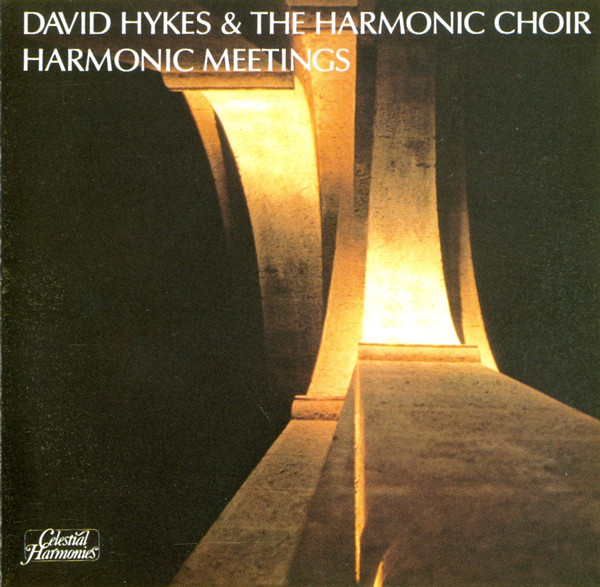
Nova Musica: David Hykes & the Harmonic Choir: Harmonic Meetings
I first encountered the 1986 album Harmonic Meetings through the recommendation of Melbourne-based musician Renato Gallina (of dISEMBOWELMENT and Trial of the Bow fame). From the very first notes, it became clear that this was not merely an album, but a carefully constructed exploration of sound, resonance, and spatialised vocal architecture. David Hykes and The Harmonic Choir have spent decades refining overtone singing, and in this recording, the human voice is elevated beyond melody and rhythm, becoming a living spectrum of harmonics. The music does not simply unfold in time, it occupies space, interacts with itself, and invites the listener to inhabit a perceptual field defined by subtle interactions of tone, resonance, and decay.
The Abbey of Le Thoronet, with its vaulted ceilings and stone walls, is integral to the recording. Reverberation is neither a background effect nor a passive space; it participates actively in the formation of sound. Each note, each harmonic, interacts with the architecture, allowing overtones to bloom, interfere, and dissolve in ways that are perceivable as spatial and spectral phenomena. The music encourages deep listening: attending to the movement of harmonics, the emergence of combination tones, and the overlapping layers that give each track both coherence and richness.
From the outset, Lines to a Great Lord establishes the tonal framework. Sustained tambura drones provide a foundation over which the choir’s voices layer with remarkable precision. Each fundamental produces a cascade of overtones that interact, generating emergent combination tones without any apparent tension. The layering is deliberate, meticulous, and spatially intelligent, with higher partials floating in perceived vertical and horizontal space while lower overtones provide grounding. Even the decay of each note is carefully controlled, producing a sense of acoustic space that is both expansive and stable.
Harmonic Relation deepens the complexity. Multiple independent lines enter, each slightly microtonally varied to create interference patterns and emergent harmonics. Despite the increasing density, clarity is maintained. Voices occupy distinct positions within the harmonic field, and their interactions produce motion without disrupting the underlying tonal structure. The music demonstrates subtle temporal shaping: small variations in onset, duration, and amplitude guide the evolution of harmonic clusters, creating a perceptible flow within what might otherwise seem a static drone.

The title track, Harmonic Meetings, emphasises sustained tones and gradual evolution. Overlapping fundamentals generate secondary and tertiary overtones, producing combination tones that are audible as emergent frequencies. The decay of each harmonic is extended by the abbey’s acoustics, allowing multiple layers to interact without masking. Listeners can observe the gradual formation of spectral clusters and perceive how high overtones occupy extended acoustic space, while lower partials remain grounded, an elegant demonstration of both technical mastery and architectural resonance.
Kyrie Fragments introduces subtle rhythmic cues that punctuate the otherwise continuous harmonic field. Sparse percussive gestures serve as temporal markers without compromising the clarity of overlapping overtones. The spectral structure remains distinct, and the natural decay of tones allows the listener to perceive both vertical layering and spatial dispersion. This integration of rhythm within a sustained harmonic environment demonstrates the choir’s ability to combine temporal and spectral structure without sacrificing transparency.
The album concludes with Halleluyah, which consolidates the principles explored throughout the preceding tracks. Overtones are systematically layered, and small microtonal adjustments create gentle modulation across the spectrum. Decay is gradual and overlapping, producing a dense, evolving harmonic texture that highlights both the choir’s control and the spatial qualities of the abbey. The final tones fade with clarity, leaving the listener aware of both the sonic structure and the interaction between human voice and architectural space.
While the music itself is self-sufficient, the listening experience can be enhanced subtly through high-resolution playback. My Kondo Overture amplifier, DeVore O/Bronze speakers, and Esoteric CD player serve not as performers but as conduits, allowing microdynamic shading, decay, and spatial relationships to emerge with fidelity. This is one of those recordings that definitely benefits from higher resolution equipment though, I think on less coherent systems everything might get lost and end up a bit messy.

Harmonic Meetings is remarkable not only for its technical control but also for its architectural intelligence. The album demonstrates how vocal technique, acoustic awareness, and systematic layering can produce a perceptible harmonic field. Harmonics emerge, interact, and decay in a controlled, observable manner; microtonal variations generate interference patterns that are measurable and audible; and spatialisation allows listeners to perceive vertical and horizontal extension within the music. Each track is a study in acoustic precision, yet the work as a whole maintains a fluidity that encourages extended, focused listening.
In discovering Harmonic Meetings, you find an experience that is as intellectually compelling as it is sonically absorbing. The meticulous layering, the control of overtones, and the interaction with space make it particularly suited for those who appreciate trance-like, meditative, or ambient music. The album encourages a mode of listening that is patient, attentive, and exploratory, allowing one to perceive the subtle unfolding of harmonics and the interplay of voice with acoustic environment. It is a rare recording that rewards repeated attention, revealing new textures and interactions with each listen.
For anyone interested in overtone singing, acoustic precision, or music that cultivates a meditative state, Harmonic Meetings is a highly recommended discovery. It combines technical mastery, spatial intelligence, and perceptual subtlety in a way that few recordings achieve. Even when encountered casually, the album invites immersion; when studied analytically, it offers a rich field of phenomena to explore. This is music that simultaneously exists as sound, architecture, and harmonic study, and it is one of the more compelling finds for those seeking deep, contemplative listening experiences.


 Audio Satori
You must be logged in to post a comment.