
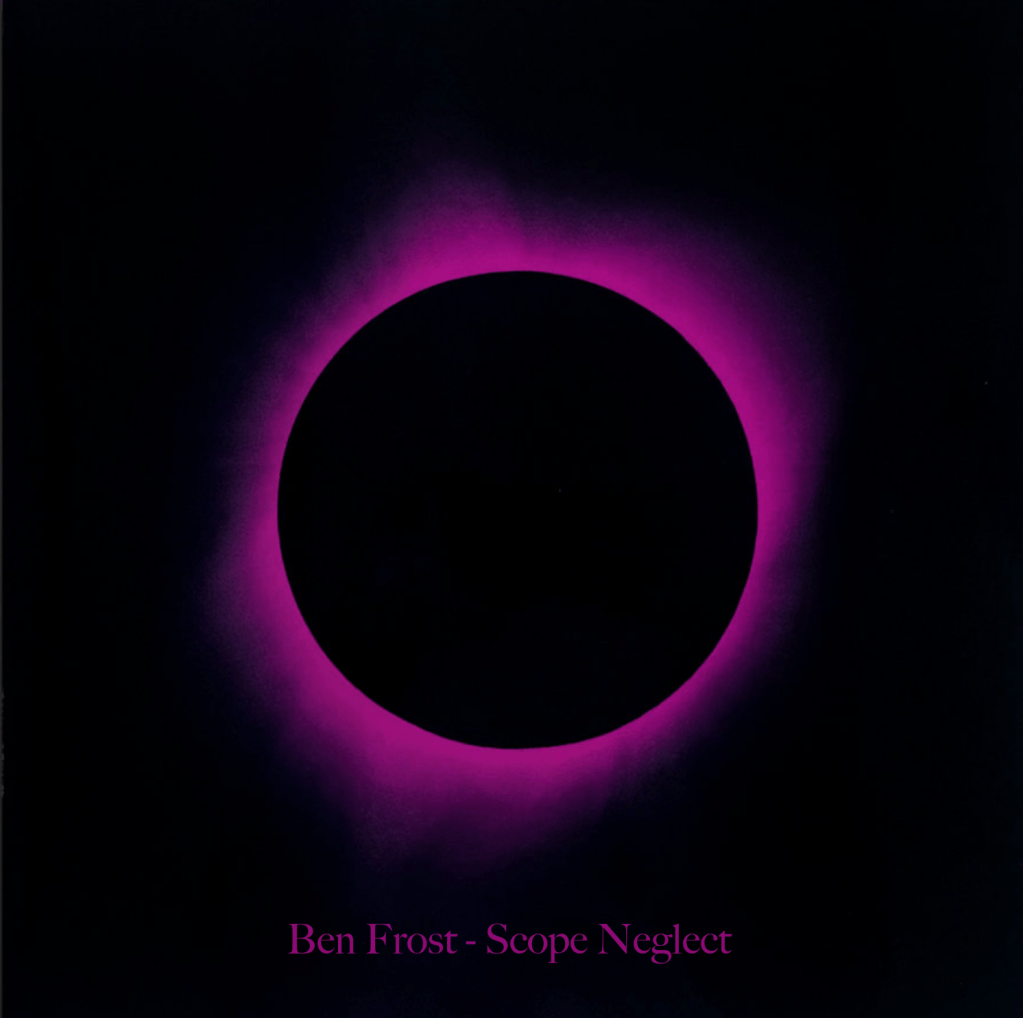
A friend mentioned, almost in passing, that there was a copy of Ben Frost’s Scope Neglect sitting at Real Groovy Records and that I should probably go and get it. So once again I braved the filth and clamour of the city centre, stopping at the same taco place I’d discovered the last time I was there visiting Marbecks during their final bricks and mortar days, dodging chemically enhanced homeless folk, religious nutters and general hoardes, before making the walk to the racks. Some rituals repeat themselves for a reason maybe. I have to admit I’m a little uncertain about Real Groovy these days. It doesn’t feel like it used to back when it was up the road from Mayoral Drive. I still lament that spaces demise. Then the store had focus, character, a sense that you might stumble onto something unexpected but meaningful. Now it feels a bit scattered, all the random stuff on the racks diluting the experience, like it’s lost a little of the mojo it once had. Still, beggars can’t be choosers and I am grateful it still exists at all. I did appreciate the $20 discount I recieved due to my long standing VIP Club membership, I did buy a few things that day so that was nice.

It was seven long years since Ben Frost last released a studio album under his own name, 2017’s The Centre Cannot Hold, and in that time he has been anything but idle, a wait that feels substantial until you remember that in some corners of the heavy and experimental world this still counts as positively brisk, especially when set against the glacial release cycles of bands like OM. Soundtracks for film, television, and games. Collaborations. Installations. A second opera. Deep immersion inside Swans’ vast and punishing ecosystem, contributing to three albums and touring as part of the band. Frost’s relocation to Reykjavík only reinforces the sense of an artist embedded in process rather than product. In that context the album as a form begins to feel almost quaint, less a default mode than a deliberate intervention.
So when Scope Neglect finally arrived to me, anticipation had fermented into something closer to hunger. Frost’s run from By The Throat through The Centre Cannot Hold, including his operatic adaptation of Iain Banks’ (RIP) The Wasp Factory, remains one of the great modern syntheses of industrial force, contemporary classical discipline, metal density, and ambient space. These were records that did not simply feel heavy. They felt necessary.
In places, Scope Neglect fully earns that expectation.
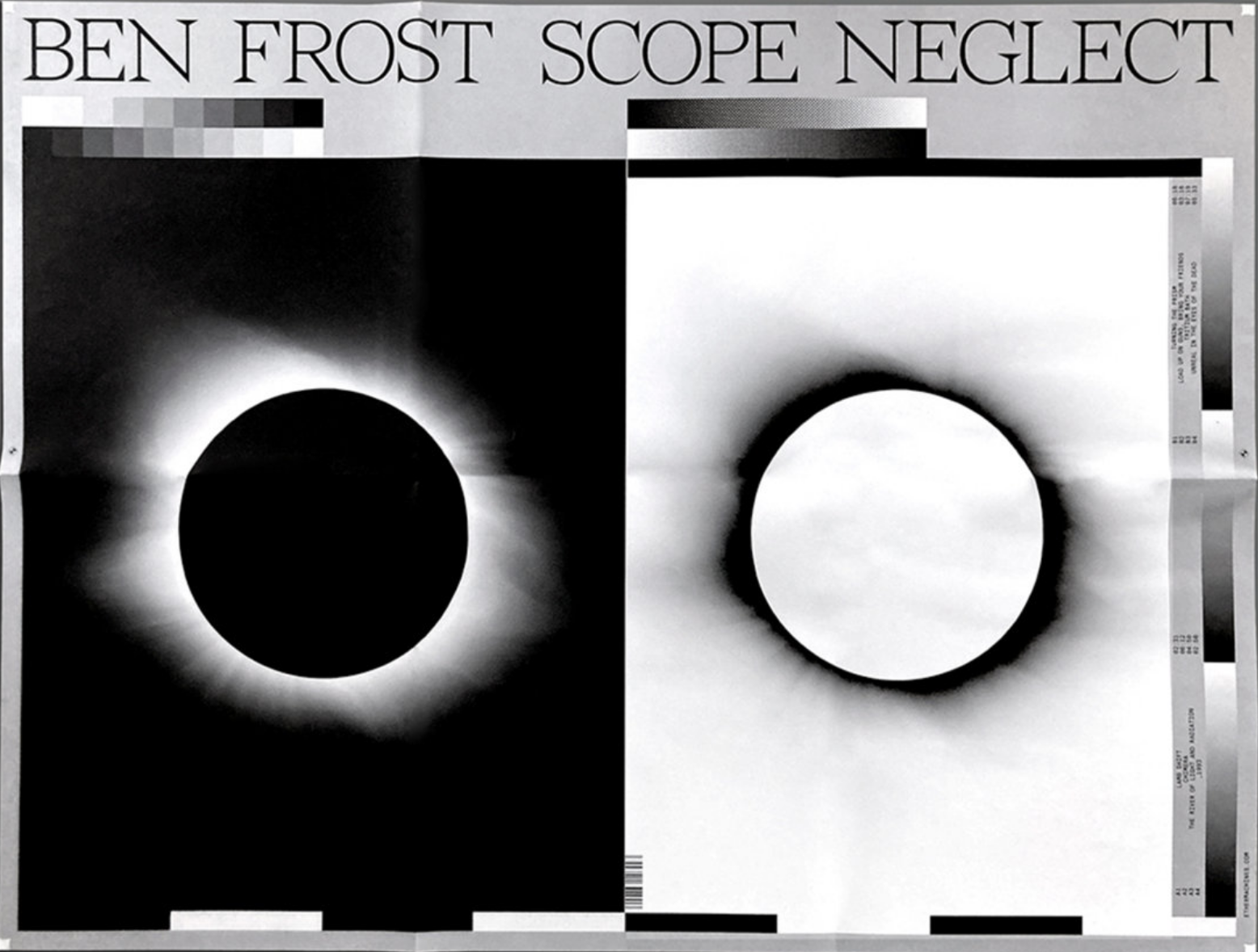
Frost leans more overtly into metal than on any previous album length statement, drawing on guitarist Greg Kubacki of Car Bomb and bassist Liam Andrews of My Disco. Kubacki and Andrews were reportedly given full orchestrations to guide the emotional contour of their performances, structures Frost later stripped away entirely in the finished record. What remains is music that resists easy emotional access. Riffs without catharsis. Momentum without release. Violence presented without instruction.
Album opener “Lamb Shift” makes this clear immediately. Alien, liminal, and genuinely unsettling, it takes familiar metal gestures and pulls them apart like a cadaver laid out for study. Time feels unstable, possibly irrelevant. Silence becomes a source of tension rather than relief. The guitar is present but denatured, stretched and dissected until function gives way to texture. There is a rare and welcome sense that the listener has no idea what is coming next.
That sense of danger peaks again on “Tritium Bath,” the album’s other undeniable high point. It opens with deceptively calm keyboard swells before being torn open by feral, eviscerating guitar. A melody tries to assert itself, something almost humane, but it is steadily swallowed by the surrounding violence. It is not easy listening and does not pretend to be, yet it is beautiful in an otherworldly way precisely because of that refusal.
Frost’s sound design remains formidable throughout. On “Chimera” and “The River of Light and Radiation,” vast hammer blows of processed sound land with a cold science fiction weight. The latter centres itself around a pulse that feels less like rhythm than physiology, closer to imagined tinnitus than beat, while Kubacki’s guitar rears and whinnies, more animal than instrument. Even when the music slows, the sense of threat never dissipates. Violence reverberates through the quieter passages like a residual charge.
“Chimera” itself oscillates in and out of focus, recalling long form ambient looping structures, but animated by vivid life rather than decay. Beauty here is not nostalgic or fragile. It exists inside chaos, not as a reprieve from it. This feels central to the album’s underlying philosophy. Meaning is not imposed. It is felt, if at all, through surrender. It does not need to make sense. Humanity’s recurring mistake may be insisting that it must.
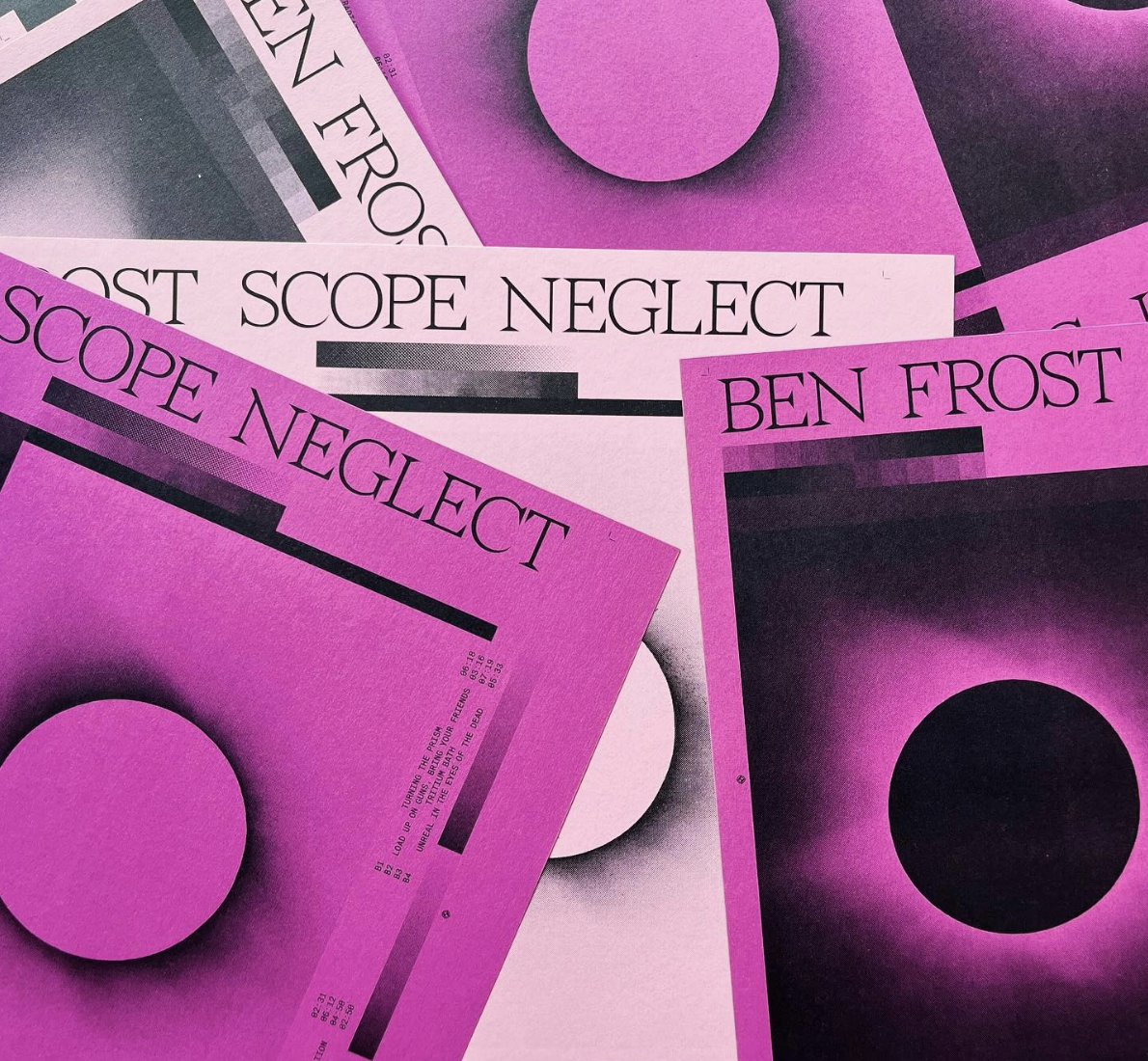
Over time, the album’s uneven density begins to feel less like a flaw and more like an intentional refusal to resolve cleanly. “Turning the Prism,” the longest piece on the record, does not explode or climax so much as persist. Arrhythmic impacts and circling guitar figures create a space the listener has to inhabit rather than consume. It asks for patience rather than attention, and rewards a certain kind of listening.
Album closer “Unreal in the Eyes of the Dead” reinforces this approach. A muted guitar figure loops endlessly, accruing only microscopic changes until it takes on a kosmische quality. Motion through stasis. Propulsion without destination. Duration itself becomes the point, not a problem to be solved.
Ultimately, Scope Neglect reveals itself as a slow burn rather than an immediate statement. It resists the demand to cohere neatly, preferring instead to exist as a series of environments. Some are violent. Some are strangely tender. All of them are charged. With repeated listens, the sense of absence at its centre softens and is replaced by something more generous. A record that trusts the listener to meet it where it is, rather than explaining itself.
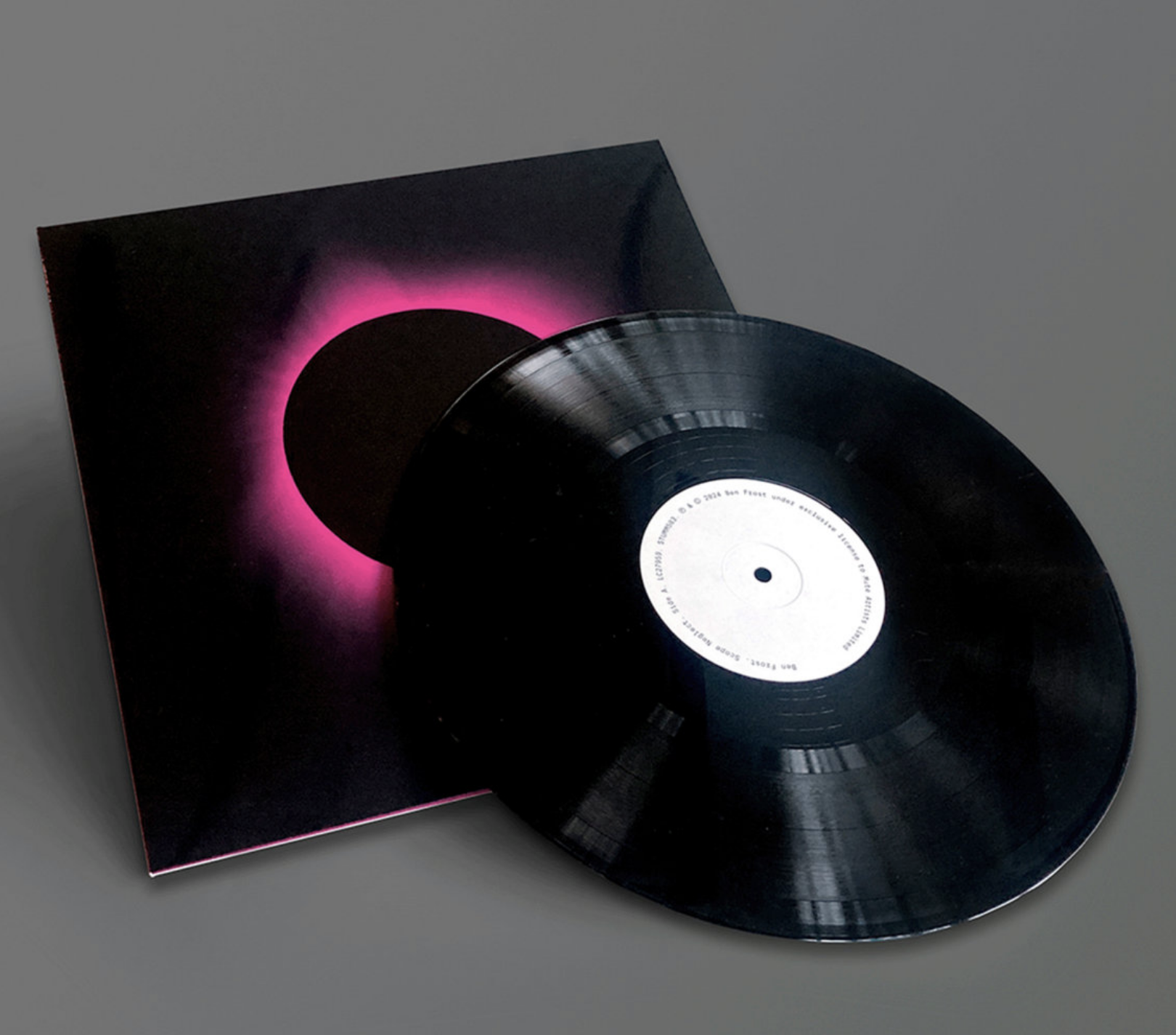
It also needs to be said that this album sounds exceptional on vinyl. The presentation feels markedly more organic than its digital counterparts, with a weight and physicality that suits Frost’s material perfectly. Bass has real mass and shape rather than just extension, moving air in the room and anchoring the more abrasive elements instead of flattening them. Imaging is superb, with sounds occupying clearly defined space and depth, allowing layers of distortion, ambience, and micro detail to coexist without smearing. Texture is where the format really earns its keep here. Guitars feel fibrous and granular, synths bloom and decay with natural authority, and the negative space between sounds becomes as expressive as the sounds themselves. This is music that benefits from being embodied, from existing as pressure and vibration as much as signal, and vinyl lets it breathe in a way that feels entirely aligned with its intent.
Played through the DeVore O/Bronzes, driven by my Kondo amp and fed by the newly installed Ortofon RF-297 with the SPU-A into the Kondo SUT and phono stage, Scope Neglect takes on an almost physical presence. There is a density and coherence to the sound that feels utterly natural, as if the system is simply stepping aside and letting the record occupy the room. Bass is deep but never overbearing, textured rather than blunt, while the midrange carries an uncanny solidity that makes Frost’s layered brutality feel carved rather than assembled. Imaging locks in effortlessly, with sound hanging in space in a way that feels organic rather than etched, and the grain of distortion and noise resolves into something richly tactile. This is a system that thrives on tone, weight, and flow, and through it the album reveals a sense of scale and menace that feels fully embodied, less reproduction than manifestation.
It may not announce itself with the brute inevitability of Frost’s earlier landmarks, but Scope Neglect feels like the work of an artist still pushing outward rather than looking back. Its rewards are cumulative, its power deepening with time. This is not a record to be exhausted in a single sitting, but one to return to, to live with. Less a comeback than a confident continuation. I like it.


 Audio Satori
You must be logged in to post a comment.