

When Sound Becomes a Sport Instead of a Pleasure
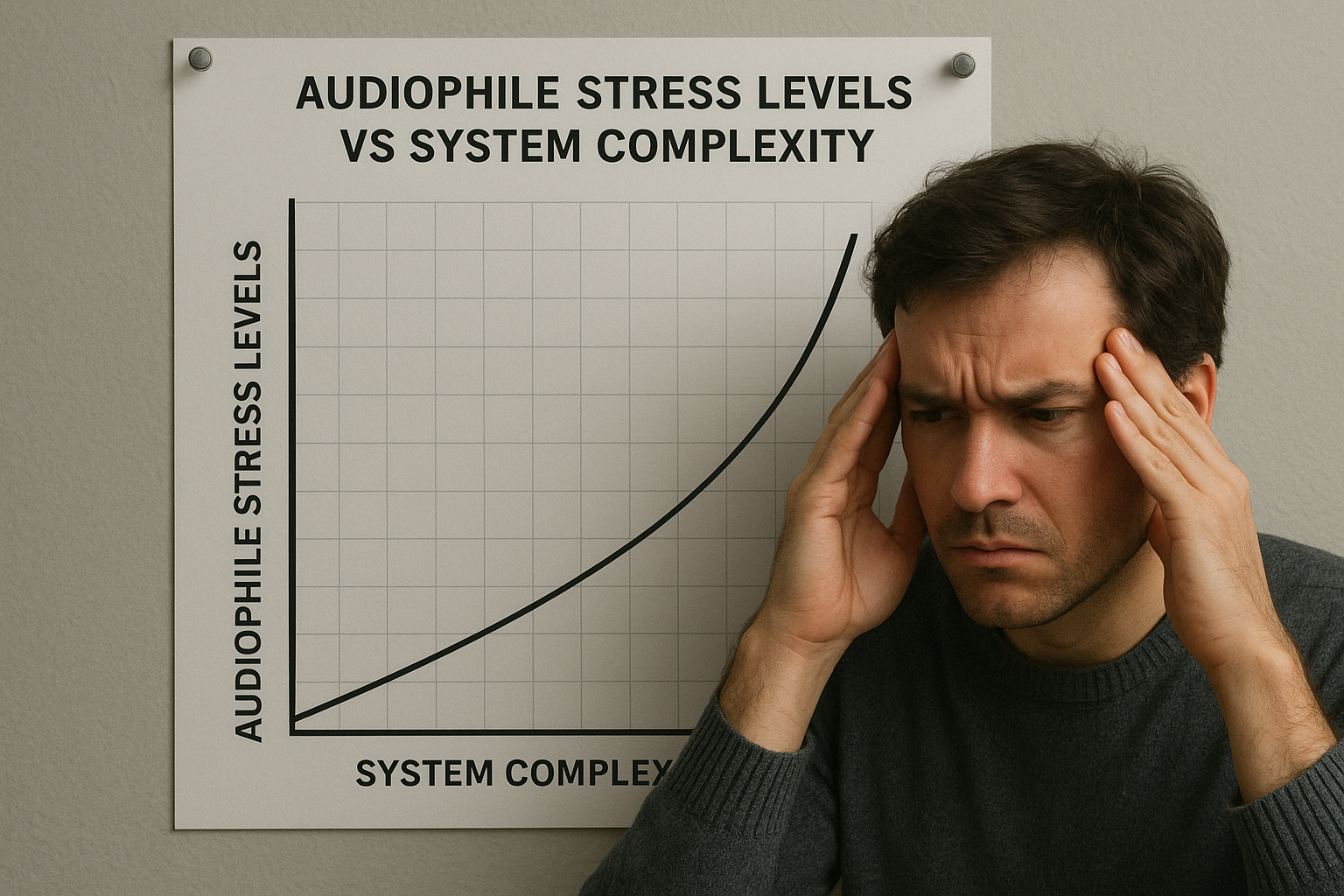
In my line of work in the audio world I meet every kind of listener you can imagine. Most people simply want good sound at home so they can relax with music they enjoy. Straightforward and healthy. But then there are the others. The more anxious, the more tightly wound, the more convinced that salvation is found in some tiny tweak or obscure specification. These are the ones carrying the full weight of audiophilia nervosa on their shoulders, and watching them is both fascinating and a little heartbreaking.
This is where the madness creeps in. It starts innocently enough, a bit of curiosity about how to get a little more clarity, and before you know it you’re three hours deep into forum threads arguing about capacitor materials with people using screen names like TubeFondler47 or FuseInserter69.
Audiophilia nervosa is not just fussiness. There is nothing wrong with paying attention to details when it actually matters, like setting up a cartridge properly, making sure the turntable is level, positioning your speakers. Those things make a real difference. The problem starts when the gear becomes more important than the music, when listening stops being fun and turns into a technical exam you never signed up for. And it sneaks up on perfectly normal people. One day you are enjoying a favourite album, the next you are sitting in the dark wondering if the black background could be even blacker.
This hobby is full of traps. There is always some new component or magic tweak claiming to reveal hidden layers of sound, because apparently we are all listening through sonically opaque curtains.
All of the characters I’ve described below are versions of humans I have actually met in my work life.

The ‘What If?’ Spiral
Once the what if spiral sets in, there is no escape.
What if the other DAC has better detail? What if a different preamp reveals more soundstage? What if the room needs diffusers shaped like medieval weapons? What if the wrong bit depth is holding me back?
Soon every track becomes a technical investigation. You’re no longer listening. You’re monitoring, checking, analysing, doing everything except enjoying music.
Tweak Oblivion
This is where the audio hobby becomes like performance art.
People start changing fuses in the hope of better timing and smoother treble. Actual power fuses. And they will listen intently and say yes, absolutely the top end is more refined now. If it makes them happy then fine, but we all know what is happening.
The latest insanity I’ve stumbled across are those “grounding boxes” filled with charcoal, crystals, and whatever mystical garden mulch the manufacturer could sweep into a jar. A wooden cube with a couple of terminals stuck on top, sold as if electrons will be spiritually guided into serenity by quartz pebbles. At this stage nothing seems ridiculous anymore, because admitting it would mean acknowledging that you spent real money on a glorified terrarium for imaginary noise. They’re expecting to see a negative reality inversion bought about by the audio equivalent of EASY-GRO fertiliser, namely a pile of shit.
Some guys even change the VTA for every single record. Every. Single. One. Life is far too short for that. If you’re retired and have endless hours to tinker, good for you, knock yourself out. But for the rest of us? Yeah nah bro, play the record, enjoy the music, move on.
Spec Sheet Worshippers
There is the camp that worships measurements. Their listening spaces are covered in printouts, noise floors, jitter plots, harmonic distortion graphs, while the actual system sits in the background untouched. This might sound far-fetched but I have seen it with my own eyes. I know a guy who keeps buying gear that never gets unpacked, let alone listened to.
Ask them what album they are enjoying and they stare at you like you asked them to recite a forbidden spell, for them the graph transcends the music.
The Audiophile Who Does Not Like Music
One of the stranger outcomes of audiophilia nervosa is that people start listening to music they do not even enjoy because the recording quality is spectacular. You will see these guys sitting through yet another audiophile-approved jazz trio even though they secretly cannot stand jazz, but hey, the cymbal decay is phenomenal. At that point it is not about music anymore. It is sonic virtue signalling.
The result is always the same: either a shockingly small library made entirely of demo tracks, or a massive collection of premium pressings, 45RPM double LPs, 180g reissues, one-step pressings, Japanese exclusives, that never actually get played. Shelf trophies. Purchased for listening, serving only as proof that the owner is Very Serious About Sound.
I’ve always enjoyed the contrast of running fairly esoteric gear and then blasting black metal or strange ambient experiments through it. There is something satisfying about pairing refined equipment with music that was clearly never meant to be treated like a delicate artifact. The texture, grit, and atmosphere all come through in a way that feels more honest than another polite jazz trio. It reminds me that the system is there to serve whatever music moves me.

Isn’t this supposed to be fun…?
The real loss is that the fun disappears. The original reason any of us got into this was because music does something emotional that cannot be explained or measured. It hits the chest, lights the brain, carries memories.
When the obsession takes over, it becomes clinical. Some listeners end up in completely serious ritualistic positions, dark room, single spotlight, sitting bolt upright like a monk preparing to summon the spirit of perfect imaging. No joy is allowed, because fun is a distraction from optimal clarity.
Why so serious?
Everyone seems to have slipped into the role of reviewer, as if every piece of gear needs a formal defence the moment it enters the house. Once you start framing your own listening in review language it gets way too self-conscious. The truth is you do not owe anyone an explanation for what you enjoy. The only people who might reasonably get a say are partners who have to live with the financial hit or another box appearing on the shelf. Beyond that, you like what you like.
Some of these guys actually arrive at the promised land. They assemble the dream system, the big glowing boxes, the racks that look like medical equipment, the cables that cost more than cars. Mission accomplished.
Except no.
The chase doesn’t stop just because you’ve ‘arrived’. These guys have sunk more into a system than some people spend on a (90’s era) house and they’re still out there, still hunting, still convinced the next piece will be the thing that finally makes it all sit right. But it won’t.
You would think having $150k worth of gear might produce a moment of contentment, but they’ve forgotten that contentment isn’t really an audiophile emotion.
And I am not above any of this. This whole blog is basically a shrine to fiddling with stuff. But here is the difference: I don’t build a temple around six audiophile-approved records, I don’t even own any of those I would think.
When I talk to clients I try to drop the seed of one small idea: the gear is the vehicle, not the destination. The point is to listen to music you actually care about, whatever that means to you.
I mean if that’s Diana Krall, Pink Floyd, Nils Lofgren, The Eagles, or Norah Jones, all power to you, they are all talented people, just not where my compass points.
The Exit Plan
The fix is not complicated. Play something you love, something that sounds like it was recorded in a shed, maybe something that takes you straight back to a specific moment in your life. Stop chasing the perfect bass response or obsessing over where the guitarist is sitting in your imaginary musical grid. Let the system do its thing. Let the music be rough around the edges. That’s where the good stuff lives anyway.



You must be logged in to post a comment.