
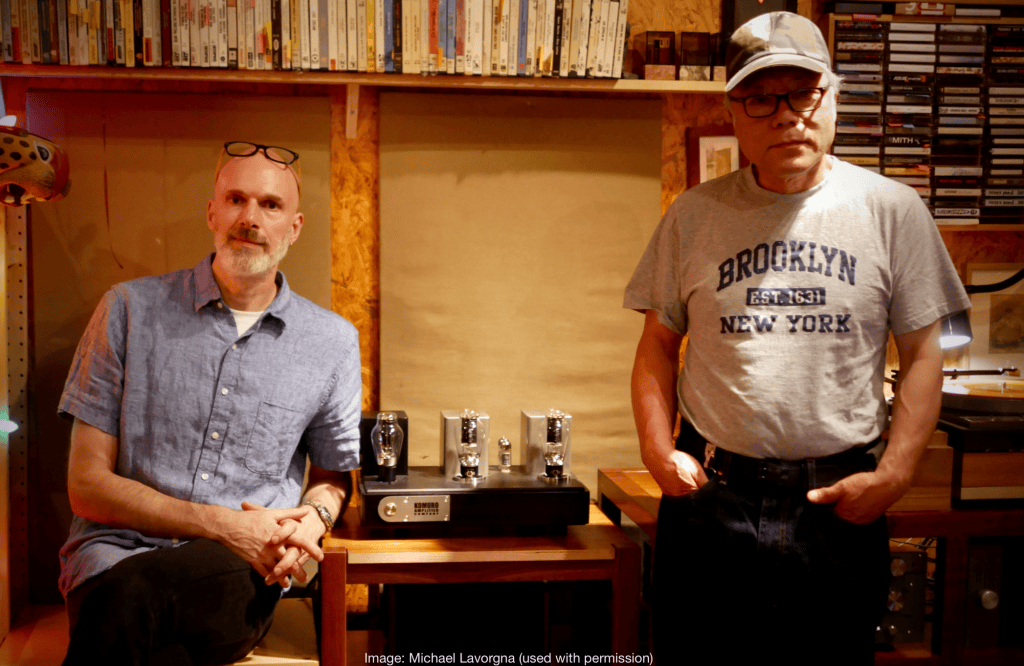
In anticipation of my amp winging its way to me, and seeing as not much info is out there about the Komuro amp story, except from what the illustrious scribe Michael Lavorgna of Twittering Machines has written, I thought I’d put a few questions to Top Banana John DeVore, and he was gracious enough to answer them.
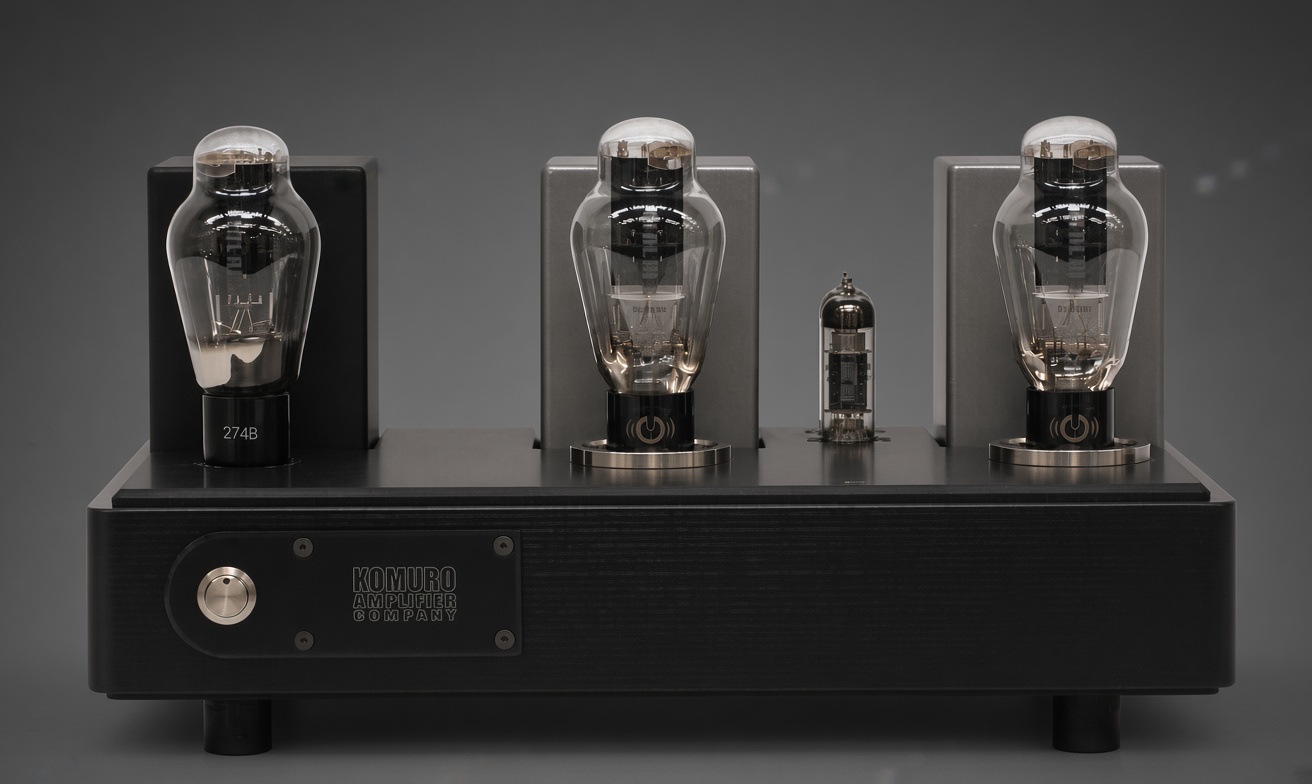
AS: How did your relationship with Komuro-san begin, and how did the idea of DeVore building a Komuro 300B amplifier come about?
JD: I met Komuro-San in 1993 at Fi, the tiny HiFi shop opened by Don Garber at 30 Watts Street in downtown New York. It was Komuro, Don, JC Morrison, and Herb Reichert among a few others coming and going. I was working at Stereo Exchange a few blocks north and quickly became friends and HiFi buds with JC. In 1996, at the Stereophile show in the New York Hilton I heard a system with JCs preamp and a pair of Komuro amps driving Evett & Shaw speakers. Easily the best sounding system at the show, a real eye-opener. A few years later JC had created an “underground” HiFi show called New York Noise. The first show I participated in with my speakers was one of these, with two pairs of speakers, one driven by JCs amps, and the other by a pair of Komuro’s amps. That second pairing was just so outrageously good. The 1990s and early oughts were Komuros heyday, but even then he doesn’t think he even made a dozen amps. He’s never really made any money from his magnificent amplifier designs. In 2020, during the Covid lockdown I had the idea to start producing his designs in series, rather than one-off commissions, so that he could finally make some money from his amps, and to ensure more people could own them–and I simply wanted there to be more Komuro amps in existence!
AS: What was it about the 300B, specifically, that made you want to build a 300B amplifier in the first place? Was there something about the way it sounded with your speakers that convinced you this was the direction to take?
What was it about Komuro-san’s particular 300B design that convinced you it was the right circuit to pair with DeVore speakers, rather than developing or choosing one of the many other 300B designs out there?
JD: When I came up with the idea of Komuro Amplifier Company, it really was to get his amps out into the world and get him some recognition, financial and otherwise. I initially purchased three designs to produce, single ended 300b, single ended 845, and push-pull 845, based on amps I had heard of his, or that I knew from reputation. I knew they sounded great with my speakers, but the O/96, O/Bronze, and O/Reference models are specifically designed to work well with a single 300B. It was not my idea to build a perfect amp for my speakers in any way. Komuros amp designs are unique, they are fully direct-coupled from the input jack to the output transformer. There are no capacitors or interstage transformers in the signal path at all. I wanted to build these amps so there would be more of these remarkable amps in the world, for use on whatever speakers the owner might wish to pair them with. We started with the 300B circuit largely because I knew it would be the most affordable. It’s the only one that can be built as a practical stereo amp, and 300Bs are legendary for a reason–a well-sorted single-ended 300B amp driving the right speakers can sound truly magical.
AS: Obviously the amplifier is designed to work well with DeVore speakers, but is there a particular DeVore model that you think forms an especially magical combination with the K300S? Or does it have a particular type of speaker load that it seems to prefer?
JD: We can wire the output transformer secondaries to 4, 8, or 16 Ohm, so as long as 6-8 Watts is enough the amp will drive a range of speakers. That said, in my experience any higher output impedance amp, like a single-ended design, sounds best driving high impedance speakers using the 16 Ohm tap of the secondary winding.
AS: How involved was Komuro-san in turning his amplifier into the K300S as we know it today? For example, were the component choices and implementation largely his, or did you have considerable freedom in translating his design into production?
JD: Komuro has been instrumental through this entire process, as I was (am) a relative n00b about amp design and construction. I’ve built and modded some amps, preamps and passive pres over the years, and experimented a lot with materials, construction, and the like, so I used this and my experience building speakers and turntables to come up with a chassis design philosophy for the products. But from early prototypes through to the pre-production versions Komuro is there answering questions and offering suggestions.
AS: What about the physical appearance of the K300S came from Komuro-san? Did he have strong opinions about the chassis, layout, materials, proportions or the way the tubes and transformers should be presented, or was the industrial design primarily a DeVore decision? I remember you mentioning that Nori wanted the chassis to be bigger.
JD: The physical design and layout came entirely from me, with attention to resonance and vibration, as well as some sort of overall identifying style. Komuro was puzzled why I made the amp so small, but that was part of the look I wanted.
AS: How did you approach tube selection for the K300S? Did Komuro-san have particular preferences for the 300B, driver and rectifier tubes, or did you experiment with different brands and types yourself?
JD: The tube compliment in the K300S is exactly as he originally drew the circuit for me in 2020. It worked perfectly with the first prototype. We did refine the circuit a bit with the following prototype builds, but the tubes remained the same. Prior to the final sign-off I compared a number of manufacturer options for each tube and selected the final units based on listening and testing.
AS: Does Komuro-san have a particular 300B that he considers ideal for his circuit? And after living with the K300S, have you developed your own preference for a particular 300B or combination of tubes?
JD: I always have it loaded with the stock tubes. Komuro has crazy tubes, like 1950s WE 300Bs and WE 274A, so it’s certainly fun to swap and hear legendary tubes, but for 90 percent of my listening it’s stock.
AS: Were there any parts or implementation details where you and Komuro-san had lengthy discussions or disagreements before arriving at the final K300S?
JD: Nope.
AS: After having lived with Komuro-san’s design and the K300S for some time, what do you think he understood about the 300B that is particularly unusual or easy for other amplifier designers to miss?
JD: During this whole process I’ve come to realize that Komuro’s approach to design is similar to mine. An intuitive sense and understanding of the various components and elements of a circuit and how they interact. Komuro is an electrical engineer with a ton of experience and a strong fundamental grasp of all the concepts, but he folds that into a very creative approach to the circuits.
Thanks John for answering my questions!
Another quote I found regarding the amp: “The original 300B SET amp I had here at the factory was the Audio Note P-3 Silver Signature, the top 300B amp AN made at the time. Several years ago I replaced that with the Air Tight 300R. The difference was striking: the P-3 always had a very full, rich, and perhaps over-polished sound, laking a bit of texture and realism. The 300R was leaner, faster, and more open with wonderful detail, but didn’t quite have the dynamic impact and solidity of the Audio Note.
In my opinion the Komuro K300S threads the needle between these two, combining the strengths while canceling the weaknesses. The K300S (and all of Komuro’s direct-coupled circuits I believe) has the best bass of any 300B amp I’ve ever heard. The impact, punch, and tonality of the bass is utterly unlike any single ended triode. Midrange and treble are very transparent, textured, solid, and a touch warmer than the Air Tight with the included 300Bs. These were my favourite of the tubes I tested with the amp, though the current production Western Electric tubes are also very good, and will give you a bit more energy in the top octaves, like the Air Tight.”
I have had both an Audio Note P3 and an Airtight 300B amp at home, and they were both really nice, so it is good to hear that JD considers the Komuro to be the best of both of those amps.
Additionally a few quotes via Michael Lavorgna’s commentary on Komuro over the years:
“This guy is one of the best audio designers alive and deserves to be known as such.” Don Garber of Fi
“Komuro is most likely the best tube circuit designer alive. His design goals are always clean, clear, wide-band, low dynamic distortion, direct-coupled, stable, durable, and oh yeah, did I mention clean and clear? Totally unflappable. Not wet, not dry, not warm, not cool, not big or small, not front or back … like clean, clear, running water! The absolute best there is with Snell, Spendor, KEF etc. I’ve had all his 845s and they are all the same — PP, SE, Class A or AB2 or ???? — like a spring-fed stream flowing past your house. You can see the colors of rainbow trout swimming between the rocks, all the way from your picture-window.” Herb Reichert
“Komuro’s amps are very special. I believe he is the greatest living tube amp designer and I’m not alone in this belief. His circuit is unique and brilliant. His amps are extremely stable and reliable without a single capacitor in the signal path. The amps are direct coupled from the input jack to the output transformer, nothing but wire and tubes for the signal to pass through. This gives them a transparency, directness, and immediacy that I haven’t heard in any other amp.” John DeVore, DeVore Fidelity
“On one hand, we can think it’s a shame that Komuro amplifiers exist well outside the mainstream. On the other hand, perhaps that’s exactly where they belong – in the homes of a discriminating and very contented few. Making music to dream by.” Me (Michael Lavorgna)”
Many thanks to Michael Lavorgna for kind permission to his pictures as well. Read his site, it is excellent.
Now I’m just hoping the Komuro amp arrives before too long. I’m very much looking forward to getting it into the system and spending some time listening to it properly. There’s only so much you can do reading about a component; at the end of the day, you want to hear it for yourself, with your own records and in your own system. Hopefully, I won’t have to wait too much longer!


You must be logged in to post a comment.